OK, so things are a bit nutty out there. We all know that, and we all know basically what to do: evaluate our goals and our path toward those goals, thoughtfully and calmly.
I recently listened in on a conversation with Morningstar’s equity analysts and investment researchers about the impact of the virus that causes COVID-19 on markets around the world. (Insider tip: It’s the same message and analysis shared with readers in our house view, because that’s how Morningstar works.)
In addition to the thoughtful analysis, I was particularly impressed by the tone: calm, thoughtful, and action-oriented. It reminded me that moments like this are about more than our own financial picture. They are about who we are as a society and how we influence one another.
How we respond to coronavirus matters
First and foremost, we need to remember that panic is a social phenomenon, whether it’s panicked selling of investments or panicked buying of toilet paper. Sure, there’s an underlying trigger, but our actions and our tone have the power to either turn that trigger into a crisis or into a blip that we quickly see in the rearview mirror.
But we don’t think about that dynamic as much. It’s not what other people do in times like this that create problems; it’s what we do. There are no “other people.” It’s true for the markets, and it’s also true for our mental health right now.
Managing the impact of coronavirus in our investments
Personally, as a contrarian investor, I try to identify buying opportunities when there’s a down market. But that isn’t all there is to it.
Morningstar director of personal finance Christine Benz and others have talked about the value of rebalancing one’s portfolio now. That’s because, generally, when stocks are down and bonds are up, we maintain our asset allocation by selling high and buying low.
This tactic also helps counter the crazy. By buying when others aren’t, we help limit the carnage, in our small way. And that helps real people avoid potentially dire situations.
As many studies at Morningstar and beyond have shown, people lock in their losses by pulling out at the bottom of a down market. It’s not the stock market decline itself that hurts them per se; it’s that they exit and then miss out on the subsequent market upswing (which will happen, it’s just a matter of time).
That’s a serious loss for retirees living off their investments or young families planning for their first house purchase. It means cutting back, living on less, and perhaps not even being able to pay the bills.
Buying when others aren’t helps decrease the chance that people will panic and pull out, and it softens the blow if they later do. Keeping our heads and thoughtfully evaluating our investments means, ever so slightly, smoothing things out for everyone else.
Managing the impact of coronavirus in our daily lives
The impact we have is felt not just in our investing but also in our daily behaviour.
Last week, I talked with an old friend about my fears around the coronavirus. We fed off each other in our fear, and it just made things worse for both of us. And we spread that message of fear to others as well.
We didn’t go out and buy face masks or such, but many others have. I know there’s already such a shortage of masks that nurses and doctors–the people who really need them—are running low. When I cause someone to become more panicked, I’m hurting my own doctors, my own family, and my own country.
Instead, we can help carry the alternative message that Benz, healthcare strategist Karen Andersen, and many more at Morningstar and elsewhere are offering: a calm, thoughtful analysis of the facts. Perhaps then, things will turn out better, both in the markets and in all of our lives.
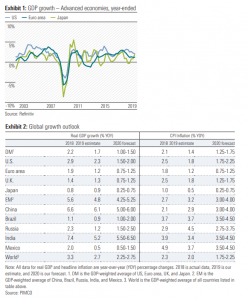
President Donald Trump trumpeted to those listening at the World Economic Forum inDavos that, “America is in the midst of an economic boom the likes of which the world has never seen before”. This description takes gilding the lily to a stratospheric level, but don’t let the facts get in the way of a good story. Exhibits 1 and 2 clearly show Trump should have gone to Specsavers! He could have added the mirage-like economic boom has been funded by a US$984bn budget deficit in 2019, which is forecast to rise to US$1.1 trillion in 2020.
Global geopolitical or trade disputes are still elevated on several fronts—US/China, US/ eurozone, US/World Trade Organisation and US/Iran. Without going to Specsavers, even I can spot the prevailing common denominator.
Just a week after signing the phase-one trade agreement, Trump has threatened the eurozone with tariffs on autos and parts if it doesn’t sign a trade deal. He wants it in place before the November election. The German ambassador to the US indicated the eurozone could retaliate with tariffs on US goods. Digital taxation has also become a potential flash point involving both the eurozone and the UK.
The outbreak of coronavirus in the Chinese city of Wuhan provided financial markets with a trigger to prick stretched valuations as the switch to risk aversion sees risk assets slip and safe-haven assets—bonds, gold, yen and swiss franc—temporarily move higher.
Financially, more serious than the outbreak of coronavirus would be an outbreak of investor complacency. Unknowns like the coronavirus are a compelling reason for investors to always be prepared and vigilant, even more so with markets near record levels. The world is not as safe socially, commercially, politically or financially as many may think.
The reaction to the coronavirus wiped out the strong gains of the three major US indices in 2020 and provided the Federal Open Market Committee (FOMC) with a reason to leave rates unchanged. Not that a change was expected. One year ago, the pivot of US Federal Reserve (the Fed) chairman Jerome Powell dramatically altered the direction of US and global share markets. Despite a 50-year low in US unemployment and the president’s Davos boast, which if true would perhaps signal a rate rise, the Fed is not about to disturb the status quo.
Brett Gillespie, the CIO of The Super Investor says, “The Federal Reserve are going to make a mistake in that they are going to fan a massive bubble. But they are not going to cause a recession.”
The FOMC left rates unchanged at the 29 January meeting but added that “uncertainties remain”, including trade and coronavirus. Powell indicated the central bank will continue to expand its balance sheet.
China: Where to now after phase-one?
With the dust now settled on the signing of the phase-one trade agreement on 16 January, Morningstar’s China Economic Committee has delved into the implications and what it means longer term. The conclusion is “the deal doesn’t materially change our outlook for China’s economic growth, especially in the long run. The deal is limited in scope and odds of success are low. More importantly, the trade war has persistently been overrated as a driver of China’s economic growth. The key drivers for China’s growth remain internal: namely the need to rebalance away from its debt-fuelled, investment-heavy growth path.”
The key takeaways from the report were:
– Official real GDP growth was steady in the fourth quarter at 6%. Our alternative broad proxy indicated a slight growth rebound for the quarter, thanks to stronger consumer goods demand.
– However, economic growth remains clearly in a downtrend, and the key cause is slower credit growth, rather than trade headwinds.
-The phase-one trade deal between the US and China is a ceasefire at best, with only modest impact on US tariffs. The deal includes a pledge from China to nearly double its imports from the US by 2021, which seems highly unlikely to be met.
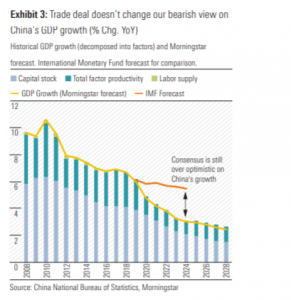
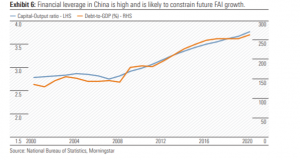
– Our long-term thesis on China’s growth is primarily driven by non-trade factors. China’s investment-driven growth model has reached the end of its rope, with China’s debt-to GDP climbing to 260%. Slower capital accumulation will drag on China’s economic growth in the next 10 years (Exhibit 3).
– Consensus is still overoptimistic on China’s long-term GDP growth.
Optimism on phase-one deal in US-China trade war is unwarranted
China equities have rallied following the signing of a phase-one trade deal, but this optimism is probably unwarranted. Overall, the deal is best described as a tentative ceasefire. It does little to address some of the core issues within the US-China relationship, such as cybertheft and industrial policy, an indicator of how little China has shifted on its
important issues.
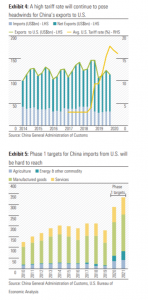
Average US tariff rates on imports from China will reduce no more than 2% from average third-quarter levels and will remain about 13% higher than before the trade war began in early 2018. Key deal terms are unlikely to be met. Most importantly, China has agreed to nearly double its imports of US goods and services. While the energy and agriculture
components of the target have some chance of success (as US commodity exports to other countries can be re-routed to China), we see little chance of success for manufacturing, targeted for an increase of US$45bn (over one third) from 2017 levels. (Exhibit 4 & 5).
Even with the pause in tariff hikes, China’s exports to the US will likely continue to fall in coming years as supply chains adjust to the higher tariffs. Meanwhile, growth in exports to non-US trading partners remained weak as global economic growth slowed. In 2019, China saw a boost in its trade surplus, thanks to an improving manufacturing goods balance. However, we think this largely represented a temporary benefit of falling manufacturing imports, as China’s producers curtailed their imports of inputs and drew down stockpiles in anticipation of falling export demand.
Fixed asset investment growth remains weak
China’s officially reported nominal fixed-asset investment (FAI) increased slightly to 5.4% in 4Q19 from 4.8% in 3Q19 but remained weaker than the 5.9% in 1H19. Morningstar’s raw materials-based monthly gauge of real FAI growth fell to 5.2% in 4Q19 versus 5.7% in 3Q19 and has trended down throughout the year. Also, materials production in 2019 has been boosted by more lax pollution controls. China’s high level of investment expenditure has driven a rising debt-to-GDP ratio. We believe investment growth will remain muted over the next decade in order to reverse these trends.
While manufacturing FAI growth rebounded to 4.7%, from 1.7% in 3Q, this was partly offset by weaker infrastructure FAI growth, which dropped to 0.9% from 4.7% in the previous quarter. The real estate sector remained the key pillar to FAI and grew 7.4%, slowing from 3Q’s 8.6%. Real estate activity should slow further, given ongoing tightening and the peak of urbanisation passing, but only at a gradual rate as the government may relax cooling measures if economic conditions worsen sharply. Real estate starts have already been weakening somewhat, which eventually should cause real estate investment to fall.
China is likely to continue to support the economy through infrastructure spending, as per the government’s recent order to speed up debt issuance for infrastructure.
Consumer demand appears to have rallied in 4Q19
Overall, consumer demand appears to have recovered in 4Q19. While headline nominal retail growth was about flat and real retail sales slipped by 40 basis points to 6% in December, our estimated demand for consumer durable goods (our preferred measure of consumer demand) spiked in 4Q19 to an almost 9% growth rate from negative 3% in 3Q19. Other official data showed solid consumer demand. The National Bureau of Statistics’ household survey data revealed consumption expenditure up 9.7% year-over-year in 4Q, down slightly from 3Q but still up solidly from 1H19.
The increase in durables demand in 4Q was broad based, with autos the exception. White goods volume (refrigerators, air conditioners, washing machines) recovered strongly. On the other hand, staples demand growth dropped to negative 0.8% from 1.2% in 3Q, owing to weak volume of meat and vegetable oil. Meat demand has been depressed by high prices due to the swine fever epidemic. Chinese equities remained elevated in 4Q, well above trade war lows. This optimism about the trade war outcome has likely contributed to the rebound in consumer demand. Consumption upgrades for Chinese consumers remain a key investment theme. We expect volume growth is likely to maintain at low- to mid-single-digits rate, due to saturated demand and weaker consumer sentiment.
However, we believe the Chinese consumers will continue to trade up as they become more affluent with increasing per capita income, aspiring to improve their life quality and perceived social standing. Meanwhile, the Chinese government has implemented a series of tax cuts in order to stimulate consumption in support of economic growth. We see corporates shifting their focus in expanding market share in the premium segment to improve overall profitability.
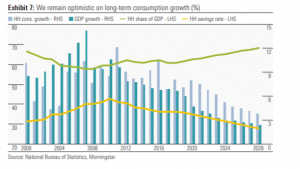
Many companies are benefiting from the progress of assets utilisation improvement and sales channel transformation. Overall, we remain optimistic on China’s household consumption growth, expecting it to solidly outpace overall GDP growth over the next decade.
Australia—A summer to forget
The value of Australia’s exports of iron ore and liquified natural gas (LNG) continues to growstrongly and drive meaningful trade surpluses. Net exports were a solid contributor to 3Q’s GDP and will provide support for 4Q and 2020. But one should not forget education and tourism rank 4 and 5 behind iron ore, coal and LNG as the country’s exports. Combined, the contribution of education and tourism to our exports exceeds $50bn annually. Both will be significantly affected by the bushfires and the coronavirus outbreak.
The economic impact of the bushfires will stretch far beyond tourism industry. The rebuilding will take years, not months. The aftermath is likely to be a drag on economic growth throughout 2020, and probably beyond. I recall the hype around the rebuilding after the Christchurch earthquake in 2011. In 2016, BBC News reported, “It has been five years since a major earthquake hit the New Zealand city of Christchurch, but thousands of residents are still waiting for their homes to be repaired or rebuilt.” Unfortunately, a similar situation is likely to repeat here as bureaucrats play havoc. I hope I am wrong.
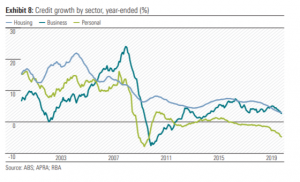
GDP growth in 2020 is likely to remain below trend. Until falling credit growth bottoms, consolidates and recovers it will be difficult for the mainstay of economic growth—household consumption—to become a meaningful driver of economic activity. A change in the direction of business credit growth will signal a return of investment activity, while increased consumer confidence will support a recovery in residential investment. (Exhibit 8)
Another quarter of benign inflation (will it ever get close to the 2–3% target?) and the trade weighted index at 58.5, will probably see the Reserve Bank leave the official cash rate at 0.75% on 4 February. The upcoming reporting season has already pricked some companies to pay a visit to the confessional. It will be a testing time for already stretched valuations despite low interest rates. Businesses don’t want to lift hurdle rates for investment because of low interest rates, but investors are apparently comfortable pushing stock prices higher and narrowing their margin of safety and lifting risk profiles by doing so.
The Impact of Coronavirus for Investors
Public health outbreaks and epidemics like the recent coronavirus can quickly scare investors and, eventually, affect economies and businesses. The recent coronavirus outbreak has shut down airports, halted trade, and led to the rapid construction of new hospitals in China. The effects of the outbreak may push China’s economy into a period of slower growth, with stocks trading lower as investors seek protection.
So, what does that mean for the portfolios we run?
Epidemics and Investing
To understand the potential impacts of an outbreak, we must make a forecast—formally or casually. This is a complex task if done correctly, and outside the scope of this piece. But it’s important to acknowledge that we’re trying to peer into the future, which is wrought with intellectual danger. No one can predict the future, but plenty of research suggest ways that forecasts can be improved.
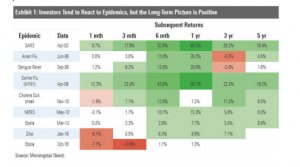
One way to improve the accuracy of a forecast is to start with base rates. How often do outbreaks become epidemics? What effect do epidemics have on economies or markets? For this latter question, we look to Exhibit 1 to provide a sense of base rates—market returns following major epidemics in recent history.
Exhibit 1 Investors Tend to React to Epidemics, But the Long-Term Picture is Positive
As depicted, market participants tend to react to such unforeseen outbreaks, but markets tend to recover by the six-month mark. This suggests that sentiment drives early losses, but sustained economic impacts are less than perhaps investors feared at the onset.
Another way to improve forecasts is through humility—especially knowing what you don’t and can’t know. Expert epidemiologists might be able to produce base rates on spread rates, mortality rates, and so on, but no one can predict how unknowable factors might affect the spread of this or any outbreak. That’s not to mention knowing how fear might affect markets.
So how can we make a reasonable assessment of the potential impact of the coronavirus? As long-term, valuation-driven, fundamentally based investors, our concern is any potential impact to businesses’ cash flows.2 For example, will the collective impact of the outbreak (fewer flights, less trade, loss of productivity, etc.) affect a few businesses, a few industries, or entire markets? That’s the question we’re asking.
Our answer is that, at this stage, we have to assume the outbreak will take a similar path to other recent epidemics, and thus we feel there’s no reason for investors to be alarmed. Note that there’s no “safe” approach for investors—for example, exiting stocks in favor of cash has its own risk, namely crystalizing any losses suffered to sentiment while almost surely missing out on a rebound if the virus were to be contained quickly. So we want to proceed by assuming what we consider to be the most likely scenario, while taking other possible outcomes into account.
Ultimately, we are very watchful but aren’t taking any action. Our core ambition is to help investors reach their goals, which requires a measured and repeatable process to investing. Across our portfolio range, we may hold exposure to Chinese stocks, emerging-markets stocks, emerging-markets debt, and companies that sell into China to varying degrees depending on the portfolio mandate. Even so, we are still expecting that these holdings will deliver positive outcomes over the long term, and it would require a clear impact to fundamentals for our view to change.
Note that once the facts change, we would expect to change our minds. If we were to see a clear and significant potential impact to investment fundamentals, we would carefully study the situation, conduct rigorous scenario analysis, and try to incorporate the new information into our portfolios. Until then, we remain vigilant.
Final Thought
With lives at stake, it would be uncaring to call the coronavirus “noise.” Yet, if we focus on the investor’s perspective, we believe it is not time to act. Moreover, we remain confident in our portfolio holdings because they reflect a solid base of research and resemble a well-reasoned way to invest. We certainly won’t be hitting the panic button and we hope you won’t either.
Nonetheless, while it remains very difficult to predict the impact that the coronavirus will ultimately have, it is worth highlighting that share and bond markets, in general, are overvalued. This means that the risk of losing money is elevated and markets remain vulnerable to any bad news, whatever the cause. In this regard, our portfolios remain defensively positioned, holding more cash than we otherwise might.
Deaths from the coronavirus are nearing 1,500 and easily exceed the 774 deaths of the SARS outbreak in 2003. Only one death has been reported outside China. From a health viewpoint, this suggests the virus is China-specific, although there are confirmed cases in 24 countries.
From an economic viewpoint, the coronavirus is and will have far reaching global implications. The market should be focused on the extent of the disruption to the global supply chain and the impact on cash flows, rather than deaths or making comparisons with earlier viral outbreaks.
Markets are currently taking a positive view and looking through the impact of the coronavirus. That is a normal reaction, but we should not underestimate the seriousness of the situation. Complacency currently knows no borders whether possible dangers are economic, geopolitical or health-related, as is the current situation. It has spread at a faster clip than coronavirus and can be just as dangerous financially.
Prolonged disruption to supply chains will have an impact on the cash flows of many companies. The strong will be OK, but companies affected are likely to include some highly leveraged zombies, companies whose interest cover (EBIT/net interest expense) is less than one, where the outcome could be less palatable.
In 2003, China represented less than 5% of the global economy. It has grown to over 17% since. Its economy is now entwined with all major trading nations. It is a meaningful source of manufactured goods and components but is also a major customer of exporting nations for raw materials, energy and finished products. The rapidly growing middle class is now the world’s largest consumer base and consumption has been slashed.
Over 80% of China’s manufacturing base has been affected by the coronavirus. Many are struggling to re-open after the enforced extended Lunar New Year holidays. The longer production lines remain silent the greater the impact on the global supply chain. The knock-on effect could have serious implications and shortages are almost certain to result. A stroll down the aisles at Bunnings will reveal the prevalence of products with a “Made in China” tag on the shelves. I estimate at least 40%.
Already a diverse selection of Australian companies including Blackmores, Cochlear and Aurizon have detailed the impact of the virus. Importers including China National Offshore Oil Corporation (CNOOC), the country’s largest importer of LNG, has declared force majeure on LNG contracts with at least three suppliers. Copper smelters have also joined the force majeure queue.
The lack of component supply has already closed auto plants in Japan and South Korea. Further disruptions to manufacturing outside China are likely as shipping schedules have been shredded, delaying the delivery of exports.
The return to normality could take weeks as travel restrictions and health precautions remain in place to stop the spread of the virus. As workers in their tens of millions return to work there is a risk of reigniting the spread of the virus.
China’s 1Q20 GDP growth will suffer a large blow as the outbreak coincided with the Lunar New Year festivities and the associated spending tsunami. This will also trim global GDP growth. While normality will return, this spending impetus has been lost.
US jobs data remains positive
The Federal Reserve (the Fed) is not concerned about the strength of the US jobs market. Its focus is on inflation and it would have welcomed the latest lift in wages growth to 3.1% year-on-year for January. It will allow the economy to “run hot” for a while before it starts the unenviable task of tightening monetary policy.
It comes as no surprise that debt disciple President Donald Trump’s wish list suggests a budget deficit of US$4.8 trillion for 2021. The danger of unfunded fiscal stimulus of an unparalleled dimension is ever present. Record government and corporate debt remains a concern.
Australia stuck in the slow lane, housing upturn continues
Business surveys from both the National Australia Bank and Westpac confirm Australia’s economy is moving crab-like, with most key metrics stuck in the mangrove flats and below trend. The government’s surplus has evaporated under the intense heat from bushfires and the untimely outbreak of the coronavirus.
December’s jobs growth of 29,000 consisted entirely of part-time positions encompassing the seasonally sensitive retail, hospitality and tourism segments. The bushfires and coronavirus have meaningfully affected all three. The January and February labour force reports are likely to be subdued, with job losses a distinct possibility.
Consumer sentiment as measured by the Westpac-Melbourne Institute Index improved slightly in February with easing concerns around bushfire-stricken communities as widespread rain doused several of the large fires. The coronavirus had a minimal impact. The overall sentiment level is still well below the long-term average and household consumption remains subdued.
There is more encouraging news on the housing front with December’s housing finance report blowing away consensus estimates. The total value of housing loan approvals grew at a 4.4% month-on-month (m/m) clip in December, well above consensus at 1.6%. This strong finish to 2019 is encouraging for 2020. Owner-occupiers are leading the charge, with first- home buyers in the ascendency. The value of loans for owner-occupiers was up 5.1% m/m and up 23% since May and closing in on the record levels reached in 2017/18. Investor interest is more subdued, as yields shrink with pressure on rents and prices rising. Despite an increase of 16% since May, the value of loans to investors is still below the 2016 low.
The test will come when supply normalises later in February and affordability issues become a little more restrictive in a low wage growth environment.
Westpac is particularly bearish, forecasting two interest rate cuts and a bout of quantitative easing. In the US the bank expects the Fed to cut rates three times, halving the federal funds rate to 0.50%–0.75%. This despite almost full employment and a 50-year low in unemployment. What nasties do they see in their crystal ball to prompt such action? And what do they mean for financial markets?
The reporting season has opened with a few surprises. Boral and Cochlear downgraded. Bapcor, Challenger, carsales.com and JB Hi-Fi have been rewarded by comfortably beating consensus. The two largest companies by market capitalisation Commonwealth Bank and CSL both reported solid results helping to underpin the market.
Healthcare sector: Oozes quality, but at what price?
Premiums abound in this quality defensive sector. The least “sexy”, glove manufacturer Ansell is the cheapest of the line-up while also boasting the lowest uncertainty rating.
Dividend yields are skinny and PE multiples are well above the elevated market average, excluding resources and financials. The three truly global companies, Cochlear, CSL and ResMed boast market shares of over 30% and are highly regarded on the world stage. All are growth companies with a strong research and development ethic deeply ingrained in their respective cultures. Financial strength is a major attribute to ensure the product development pipeline is free flowing.
The healthcare sector is Australia’s corporate gold medal winner, hands down. I believe CSL is the best managed Australian company by a meaningful margin.
While not suggesting investors exit the sector, even the share prices of the best companies retrace to some extent in a market correction
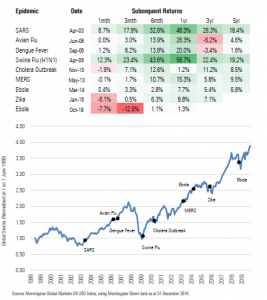
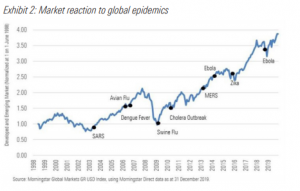
In six months’ time, we’ll be looking back at the coronavirus, mourning its victims and at the same time marvelling at the resilience of markets. History may be no judge of future performance but in this case it is a reminder of how past outbreaks have left a shallow impression on markets.
From the SARS outbreak in 2003 to the twin strikes of ebola in 2014 and 2016, and a bout of Zika in between, disease has made headlines and jostled markets. But each time, the outbreaks – and the financial losses – were eventually contained.
“Market participants tend to react to such unforeseen outbreaks,” says Morningstar Investment Management’s Carolyn Szaflik, “but markets tend to recover by the six-month mark.
“This suggests that sentiment drives early losses, but sustained economic impacts are less perhaps investors fears at the onset.”
Before we look at some impact and opportunities created by the coronavirus, a word on how markets have reacted to previous outbreaks.
From SARS to ebola: market immunity
Since 1998 there have been nine global epidemics but little evidence linking them to long-term fundamentals, says Szaflik. For investors, that means avoiding the hysteria and focusing on the factors that make businesses worth investing in.
Exhibit 1: Investors tend to react to epidemics, but the long-term picture is positive
A key consideration for the moment is the potential effect of coronavirus on cash flows. And there’s already enough to think there will be fallout, notes Szaflik. Empty streets in China, fewer flights, fewer customers, less turnover, and crucially, a hit to global supply chains and a drop in output for the world’s largest economy. The damage will emerge in future earnings reports.
Exhibit 2: Market reaction to global epidemics
That said, it’s not necessarily a trigger to dump stocks, crystallise losses and seek refuge in cash, says Szaflik. Share prices may have dropped but China is on the case. Its stimulus measures have curbed the losses and the country’s central bank is set to lower the lending rate and relax rules around how much money banks have to keep in reserve.
So what to do? Perhaps heed that old remark often attributed to Keynes: “When the facts change, I change my mind. What do you do, sir?” It’s a bit
like that now. Watch and wait, says Szaflik.
“If we were to see a clear and significant potential impact to investment fundamentals, we could carefully study the situation, conduct rigorous scenario analysis, and try to incorporate the new information into our portfolios.
“We certainly won’t be hitting the panic button and we hope you won’t either.”
Let’s examine the extent to which sectors and companies linked to China will be affected.
Opportunities among smartphone supply-chain operators
The latest sell-off creates a good opportunity to pick up shares of Hon Hai Precision (TAI: 2317) and Largan Precision (TAI: 3008), which are trading at respective discounts of 20.0 and 11.1 per cent below estimate of their fair values, according to Morningstar analyst Don Yew.
Yew has left his fair value estimates unchanged for Hon Hai Precision, Pegatron (TAI: 4938), Largan Precision, Catcher Technology (TAI: 2474), MediaTek (TAI: 2454), AAC Technologies (HKG: 02018), Sunny Optical (HKG: 02382), and Luxshare Precision (SHE: 002475).
He argues the potential disruption to the smartphone supply chain is limited because:
1. The bulk of coverage companies’ production sites are outside of the virus epicentre of Hubei province
2. For companies with production facilities in Hubei, such as Hon Hai and Luxshare, their contribution to the companies’ overall sales is immaterial
3. Smartphone vendors such as Apple typically maintain a diversified supply chain with 2-3 alternative suppliers for each component
4. The expansion of production facilities outside of China (to India, Vietnam, and Indonesia) by supply chain players helps to mitigate the risk of a pandemic across Mainland China beyond just Hubei Province.
Overnight, Hon Hai Precision downgraded its 2020 revenue outlook afterimposing strict quarantine at its main iPhone-making base, Bloomberg reports. The lost production prompted Hon Hai, known also as Foxconn, to slash its forecast for revenue growth in 2020. The company is now projecting a sales increase of 1 to 3 per cent this year, chairman Young Liu told Bloomberg. That’s down from a 22 January forecast of 3 to 5 per cent, before the epidemic spread around the globe, and lags the 5.4 per cent average of analysts’ projections.
Automakers set to benefit from panic buying
Values for carmakers remain unchanged but there will be a modest bump, says Morningstar equity analyst Ivan Su. And that’s chiefly because people will shun public transport in favour of private means of getting about. But Su insists it won’t be a long-term trend.
That said, empty streets in China also mean that fewer people are visiting car dealerships.
“But once the spread comes under control, heightened anxiety over using public transportation and ride-hailing services will push some people over the fence to purchase a vehicle,” says Su.
“Assuming the epidemic will peak in the next month or two, we expect the coronavirus outbreak to have a positive impact on China’s light vehicle demand in 2020.”
Further south in Hong Kong, the city’s metro system, operated by MTR Corp (HKG: 00066), is expected to suffer a temporary hit. But given the recent social unrest, the forecast was already bleak, says Morningstar analyst Michael Wu. MTR is roughly trading at fair value.
“Our fair value of HKD48 is unchanged and we see further weakness in its share price as an opportunity for long-term investors to enter the narrowmoat rated rail operator,” says Wu.
Travel and tourism names to be infected
The SARS outbreak of 2003 killed nearly 800 people. But back then China was a different place: it didn’t have the high-speed travel network it does today. Nor did it have a growing airline industry. And its population was less affluent and less mobile.
“Since SARS did not have a long-term effect on the financials of the companies we covered at the time, we believe this most recent outbreak is likely to lead to only short-term risk,” says Morningstar equity analyst Chelsey Tam.
She believes opportunities may exist in several undervalued companies, including online travel agent Trip.com (NAS: TCOM), and gaming houses Melco Resorts (NAS: MLCO), MGM China (HKG: 02282) and Wynn Macau (HKG: 01128).
Airlines and airports are in the immediate firing line, but the shock is expected to be short-lived, Tam says, lasting a few months. Routes to and from Wuhan, where the virus originated, will be hit the hardest. Among the three largest carriers, China Southern Airlines (SHG: 600029) is most exposed to the Wuhan civil aviation market, followed by China Eastern (SHG: 600115) and Air China (SHG: 601111).
On a company level, though, the Wuhan market is only a small portion of China Southern’s business, around 5 per cent of the airline’s passenger carrying capacity. “However, given the public fear that the coronavirus has already spread to other regions in China and other countries, we expect to see a wider effect.”
When SARS hit, the numbers of airline tickets sold through Trip.com fell 36 per cent to 70,000. But in the following quarter, they rebounded to 180,000. Revenue at Trip.com consequently fell by more than 40 per cent but rose 196 per cent the following quarter. Similarly, room nights in the second quarter of 2003 fell 43 per cent but quickly rebounded by almost 170 per cent. In short, demand stalled but didn’t evaporate.
In Australia, China, excluding Hong Kong and Taiwan, represents about 7 per cent of international passengers for each airport, the most substantial source of traffic outside of Australasia.
Sydney Airport (ASX: SYD) and Auckland Airport (ASX: AIA) are both overvalued so the impact of the virus will be muted, says Morningstar director of equity research Adam Fleck.
The peak of the SARS epidemic (December 2002 to June 2003) hurt international passenger traffic by about 7.7 per cent at Sydney Airport while in Auckland the loss was negligible. Both airports reported a rebound in subsequent periods.
From June to December in 2003, international traffic rose 3.1 per cent for Sydney and 9.2 per cent for Auckland. The rise in the six-month period ended June 2004 was even stronger: 17.6 per cent for Sydney Airport and 18.8 per cent for Auckland.
Fleck anticipates a similar rally this time around and has left unchanged his $7.30 fair value estimate for narrow-moat Sydney Airport and $7 for widemoat Auckland Airport.
Healthcare stocks: finding a cure
Many commentators and strategists argue that any slowdown will be temporary and that Chinese policy steps are reason to remain optimistic about the growth outlook, but so far public health officials have found no way to stop the spread of the virus both inside and outside of China. The virus has claimed almost 500 lives.
Investors have been eager to find companies that have the most promising technologies for containing the spread of the virus and helping infected patients recover, says Morningstar equity analyst Karen Andersen.
For example, shares of US biotech Gilead Sciences (NAS: GILD) jumped on Monday as investors processed the news that the first confirmed US case of 2019-nCoV appears to have responded to Gilead’s investigational Ebola virus treatment remdesivir.
However, unless 2019-nCoV has staying power, most of these sales tend to reverse in the following year, limiting the impact of any valuation effect, Andersen says. Gilead is already at a 20 per cent discount to Andersen’s fair value estimate, which remains unchanged.
Four-star Swiss biopharmaceutical and diagnostic company Roche Holding (OTCMKTS: RHHBY) (fair value estimate unchanged) may also benefit as the need for diagnostics increases. Medical supplies (preventive products like masks and soaps and commodity hospital supplies like saline solutions) may also enjoy increased short-term demand.
However, Andersen assumes no meaningful long-term financial impact from the outbreak.
“Most of the supplies used to prevent the spread of viruses tend to be commodity-like products, so there is more limited ability for firms to retain excess profits, especially over the long term.”
Luxury stocks pay more dearly this time
Chinese are earning a lot more than they did in 2003. Perhaps in a bid to boost sentiment among its 1.4 billion coronavirus-fearing citizens, China last week reported that per capita GDP had burst through the US$10,000-mark in 2019.
Little wonder their appetite for luxury goods has risen. And in the coming decade it could grow by 5 to 7 per cent, says Morningstar analyst Jelena Solokova.
Consequently, Solokova reckons the coronavirus could whack margins among luxury goods makers more than the SARS virus did. The share of Chinese luxury purchases rose from just over 2 per cent global share at the time of the SARS epidemic to 35 per cent currently.
And don’t forget, when the Chinese buy luxury gear they often go abroad to do it so travel bans could bite. “Mainland China accounts for 11 per cent of luxury purchases and Hong Kong for a low single digit, the bulk of Chinese luxury purchases are made abroad and can be hit by travel restrictions,” Solokova says.
But she is nevertheless sticking to her fair value estimates for luxury stocks, especially since many remain at close to record high multiples.
She still sees value in the following names:
Richemont (SWX: CFR) (wide moat, 4-star rating, revenue exposure to Chinese consumers 40 per cent)
Swatch (SWX: UHR) (narrow moat, 4-star rating, sales in greater China of 36 per cent)
Dufry (SWX: DUFN) (narrow moat, 4-star rating, exposure to Chinese consumers around 6 per cent and 13 per cent of revenue in Asia, Middle East and Australia)
Hugo Boss (ETR: BOSS) (narrow moat, 4-star rating, 15 per cent of sales in Asia)
Pandora (CSE: PNDORA) (no moat, 4-star rating, 9 per cent revenues from China)
Gaming and leisure stocks: dip in revenue
Morningstar’s fair value estimates of gaming and leisure stocks remain unchanged despite a predicted drop in activity.
As one of only six casino licence holders in Macau, Melco Resorts and Entertainment remains a four-stock stock, trading at a 30 per cent discount to its fair value of $31.
Morningstar analyst Chelsey Tam now expects revenue and adjusted pretax earnings in 2020 to be down 6 per cent and 11 per cent year over year, respectively, as a result of the coronavirus.
“This is based on our assumption of three months of approximately 80 per cent decline in gaming and hotel revenue in Macau on a year-over-year basis, followed by eight months of pent-up demand, with revenue 15 per cent higher than normalised revenue assumptions.”
Quarterly gaming revenue is not available publicly, but the annual gaming revenue increase shows the short-term nature of the SARS outbreak. “What is different now is that the gaming industry is a lot more mature, thus we expect any recovery to be much smaller in percentage terms”.
Australian casino operator Crown Resorts (ASX: CWN) remains a three-star stock and is trading near it’s fair value estimate of $13.80. While it’s too early to measure the drop-off in numbers, Chinese gamblers are a lucrative presence at Crown’s tables, says Morningstar equity analyst Brian Han, particularly high rollers, who add about 20 per cent of normalised group revenue.
Han, however, sees the potential for the virus to hurt visitor numbers at theme park operator Ardent Leisure Group (ASX: ALG). The company’s Dreamworld site on Australia’s Gold Coast is a tourist magnet and could suffer as China has been the city’s top international market, with more than a quarter of a million Chinese visitors a year.
Ardent has surged almost 60 per cent in the wake of a fatal accident in 2016. And while Han is confident the company is climbing back he concedes the virus will hurt.
“The current spreading of coronavirus could make this path even rockier in the near term, as Chinese travellers account for a meaningful percentage of overseas visitors to the Gold Coast, around 10 per cent,” Han says.
“Longer term, we are confident theme park EBITDA can return to $31 million in five years’ time, from $10 million loss last year, and in line with the $32 million average EBITDA generated in the six years before the Dreamworld tragedy.”
In the current climate, many advisers are struggling with the paradox of where they see the industry is headed vs the turmoil they are experiencing. There is widespread optimism around the move to independence and the professionalisation of financial advice, yet the immediate uncertainty and unravelling of the landscape following the Banking Royal Commission, is causing many advisers to rethink their business models and even their careers.
Until this year, advisers have benefited from being part of large institutional networks, with services being subsidised or delivered to them at a price point that reflects the scale of their licensee’s operations. However, with the shifts in the licensee landscape, many advisers have come to realise the true cost of running a business in 2019 – and it’s not always pretty.
Then, there are the decisions advisers are faced with. Self-licensing or not? Which licensee offers the right levels of service, protection, value, opportunity. Do advisers stick with familiar technology solutions or try something new? If the latter, how many solutions should be tested? Will they work together seamlessly and how can that be validated before committing? Or do you restrict your search to well-capitalised firms that share your values, and trust them to deliver. And then there’s the day job – looking after clients. It’s all-consuming.
2020 will be the year all this comes to a head, and the industry begins to resemble its future self. Those with a clear business plan will feel more comfortable heading into 2021, with the removal of grandfathered commissions looming. A clear technology strategy will be key too – record-keeping is no longer negotiable, scaling your business is impossible without integrated digital solutions, and the ability to deliver compliant advice (and sleep easy at night) is enabled only by a solid technology foundation.
At Morningstar, we’ve been working hard on our solutions to support advisers in this environment. We’re driven by our mission – empowering investor success – in everything we do. And the work we do with advisers is paramount to that mission. We’re committed to supporting advisers in running efficient and compliant practices, delivering superior investment outcomes and engaging effectively with clients.
When I look back on 2019, it’s been quite a year, delivering on that mission and vision;
We’ve launched Research Advisory, our investment consulting solution that supports advice licensees managing APLs, model portfolios and managed accounts, backed by Morningstar’s independent research.
We’ve brought new features to Adviser Research Centre, to help advisers dissect investments and portfolios – and tell their investment story effectively to clients.
We’re helping more advice groups efficiently manage their APL and portfolio reporting via Morningstar Direct.
Morningstar survey explores the priority and pain points of marketing for financial advisers
To better understand advisers and the investors they serve, Morningstar surveyed 663 financial professionals earlier this year. While our surveys were comprehensive—identifying pain points, business goals, and more—they also yielded meaningful insight about a hot topic for financial professionals: marketing.
How do advisers currently view marketing?
In Morningstar’s 2019 Adviser Insights Survey, researchers asked about advisers’ business priorities, pain points, client-management techniques, and overarching goals.
When asked to rank their business goals for the next five years, most advisers ranked “growing the business via more clients” as most important. The full list of advisor priorities is shown on the chart below.
However, most advisers also ranked “acquiring new clients” as their number-one challenge to growing their business—suggesting that finding new clients is both a priority and a pain point. The full list of adviser challenges to business growth is shown on the chart below.
And this makes sense. The proliferation of robo-advice, independent advisers with broad-reaching investment products, and easily accessible financial information means that being a financial adviser is more competitive than ever. Plus, the emerging group of investors tend to have different values and preferences than previous generations. These factors mean that in order to keep their businesses afloat, financial advisers must continue to demonstrate the evergreen value of their advice.
To better understand how advisers are responding to this challenge, our survey drilled down into the strategies that advisers use to try to grow their business. “Getting referrals to acquire new clients” was chosen by 85% of clients, and 78% selected “increasing business from existing clients.” But the percentage of advisers who reported using marketing to acquire new clients was only 33%.
Given the research demonstrating that advisers recognize both their desire and need to acquire new clients, why is this statistic relatively low? Perhaps it’s because there’s a need for support to help advisers market themselves effectively.
Marketing for financial advisers is all about knowing the investor
In another Morningstar study, researchers Sam Lamas, Ryan Murphy, and Ray Sin asked two groups to rank 15 attributes of financial advisers in order of importance. The first was a group of investors who were asked: “What do you value most when selecting a financial adviser?” The second was a group of advisers who were asked: “What do you think investors value most when working with a financial adviser?”
In a perfect world, advisers and investors would be completely aligned about which adviser offerings the investor finds valuable. However, findings from Morningstar’s research team suggest a substantial disconnect between what advisers think investors value and what investors actually value.
The biggest gaps in attributes that advisers and investors found valuable were:
Can help me maximize my returns, which investors ranked as the fourth most important attribute and advisers ranked as the second least important attribute.
Helps me stay in control of my emotions, which investors ranked as the least important attribute and advisers ranked as the 11th most important attribute.
Understands me and my unique needs, which investors ranked as the seventh most important attribute and advisers ranked as the most important attribute.
Overall, the study’s findings also suggest that investors seemed to undervalue adviser offerings related to behavioral coaching, like “helps me stay in control of my emotions” and “acts as a coach/mentor to keep me on track.”
Our findings expose a major pain point that could be inhibiting an adviser’s ability to market themselves to new clients. If advisers are disconnected with what attributes investors value in financial coaches, then they may be making strategic mistakes when advertising themselves.
Specifically, if investors are undervaluing certain adviser offerings, then advisers need to add an educational component to the way they market themselves in order to appropriately bridge that gap and demonstrate the value of those offerings.
Empathy: The heart of marketing for financial advisers
Conventional wisdom can brand marketing as a time-consuming, expensive endeavor. Therefore technologies that can help advisers communicate their value to clients in easy-to-understand, customisable reports, like Morningstar Reporting Solutions, are essential to staying competitive in the financial industry.
Still, at the heart of marketing is empathy, which entails “walking around in your client’s skin” to understand their stories, needs, and challenges. And empathy doesn’t require emptying the bank.
Ultimately, it’s about communication: Talking to prospects and clients more directly about what they value and are willing to pay for. Buying a cup of coffee so you have a chance to hear a client’s thoughts might be the best $5 an adviser ever spends on marketing.
Once empathy is achieved, advisers can begin to close the marketing gap and effectively demonstrate that, more than ever, empowering smart financial decisions starts with good advice.
Elizabeth Brigham leads the marketing team for the Morningstar software product group.
Financial adviser value is evolving—are your clients up to speed on what it can entail?
Advisers face many obstacles, but when we asked them what their biggest challenge was, we quickly found that many related to one overarching theme: financial adviser value.
The graphic above shows that some of the top challenges for advisers include: showing their value compared with robo-advisers and peer advisers, improving their value by using the most efficient software, prioritizing their time well, and meeting their clients’ ever-shifting preferences. All these various challenges come back to the core principle of value and, specifically, demonstrating that value to clients.
One reason advisers struggle to communicate this value could be the discrepancies between what investors actually value and what financial advisers think investors value. In our research, we found that these two groups’ perspectives don’t always align.
Here, we discuss what contributes to this gap and how advisers can help bridge it.
What we can learn from the gaps
For this research, we asked individual investors to rank a set of common adviser attributes—such as “Helps me reach my financial goals” and “Understands me and my unique needs”—in order of importance. We also gave the list to advisers and asked them to rank the attributes in the order they thought investors found most valuable.
As we explained in a previous blog post, when we compared the average rankings of both groups, there were quite a few crucial disagreements. However, many of them can be mitigated through proper communication.
How to help clients understand the true value of your financial advice
Because of these discrepancies, it’s important for investors and advisers to effectively communicate and ensure that they’re on the same page about the client’s goals.
Here are three key topics advisers should broach with clients to help communicate their unique perspective and value.
Demonstrate the importance of personalized goals-based planning. Implementing a goals-based strategy can increase a client’s wealth by more than 15%. This may come as no surprise to financial professionals, given the known benefits of personalized advice, but individual investors may have a different perspective. Our research found that although financial advisers think that personalisation is very important for their clients, individual investors ranked it much lower on their list. Given the effectiveness of personalized advice, advisers should not take for granted that investors are committed to a goals-based strategy. Rather, they can provide a high-level overview of a goals-based strategy’s effectiveness to help investors understand the impact it can have on their overall wealth.
Introduce clients to the world of behavioral coaching. The modern adviser is now also a behavioral coach: Someone who helps their clients weather market volatility and stay on track with their financial plan. This service is both unique to in-person advisers and extremely effective at improving their clients’ performance. But unfortunately, it’s another attribute investors take for granted—in fact, they ranked it as the least valuable attribute. To help more investors understand the value of behavioral coaching, advisers can start introducing clients to the field of behavioral science. You can get started with the resources and exercises we created for advisers to use with clients and display the importance of behavioral finance in investing.
De-emphasize maximizing returns. The role of an adviser has evolved substantially since the time when investors only went to advisers for stock tips or investment strategies. Some clients, though, may be stuck in the past. In our research, investors continued to rank “Helps me maximize returns” high on their list. To help clear up this misconception and demonstrate deeper value, advisers can provide examples where chasing returns can hurt an investor’s progress toward their goals. For example, a client that is three years from retirement should focus on maintaining their wealth, not taking on risk to increase return.
Showing the breadth of financial adviser services
Our research points to one overall finding: Financial adviser value is currently misunderstood. The role of an adviser is no longer just to be an investment expert; it’s also to serve as a behavioral coach, financial counselor, budgeting master, and more.
Advisers wear many hats, and the evidence suggests that investors are having trouble recognizing all the ways an adviser can help them with their finances. Having these conversations with clients may help.
Download our full report to read more about our research and access our worksheet to help identify what your clients value in an adviser.
(This article was updated on 28 January 2020 to reflect developments subsequent to the original publication. Other articles on this subject are published here and here).
A record amount of over $4 billion was invested in new Listed Investment Trusts (LITs) and Listed Investment Companies (LICs) during 2019, up from $3.3 billion the previous year. Fixed interest LITs were one of the success stories of the year, with $2.2 billion raised in four issues.
The overall sector now holds $52 billion across 114 issues, and while the fixed income LITs are trading close to the value of their Net Tangible Assets (NTAs) value, most equity LICs are struggling at price discounts to NTA.
But suddenly, there is also a cloud hanging over all new issuance, with financial advisers and stockbrokers unsure whether they can accept selling fees under the Financial Planners and Advisers Code of Ethics 2019 Guidance (it is a guide, not legislature). Amid the uncertainty, well-known global managers such as PIMCO, Neuberger Berman and Guggenheim are hoping to issue in early 2020.
Will advisers participate? Prominent columnist and fund manager, Christopher Joye, opened his Australian Financial Review article on 13 December 2019 in no uncertain terms:
“From January 1 commissions on listed investment companies and trusts will be banned, opening the way to huge compensation claims for losses incurred by any clients other than sophisticated institutional investors.”
The Financial Adviser Standards and Ethics Authority (FASEA) has advised me that Chris Joye’s interpretation is incorrect, and this article will explain why. However, a high level of confusion over the proposed Code remains.
Are financial advisers caught in another trap?
In the worst position of all, financial advisers are unsure whether they will breach their Code of Ethics from 1 January 2020. The selling fee for placing clients into new LITs was one of their few bright spots in a tough 2019. The uncertainty arises just when it seemed there was little more that could be thrown at advisers already reeling from:
the Royal Commission identifying conflicts of interest and not acting in the best interests of clients
a mountain of compliance and paperwork at every client interaction
the early removal of grandfathered commissions
the exit of the major banks which were once big supporters, and
new education standards pushing thousands out of the profession.
FASEA has produced detailed obligations “that go above the requirements in the law”. It includes five values and 12 standards, and they are imposed on financial advisers personally:
“You have a fundamental, personal, professional obligation to understand and to adhere to your ethical obligations under the Code. You cannot outsource this responsibility … You will need to keep appropriate records to demonstrate, if called upon, your compliance with your obligations under the Code.”
With responsibilities that are almost impossible to quantify and judge, the five values are Trustworthiness, Competence, Honesty, Fairness and Diligence, followed by pages of definitions. Advisers will not be able to pick up the phone to a client without worrying if they have met all potential requirements. The concern is that costs are rising so much that financial advice will increasingly become the domain of the wealthy.
Where do LICs and LITs come into it?
The impact of FoFA on funds and listed vehicles
The Future of Financial Advice (FoFA) regulations prohibit payments from product manufacturers to financial advisers. However, in 2014, the Coalition granted an exemption from FoFA for financial advisers and brokers to continue to receive commissions in the form of ‘stamping fees’. Under Corporations Regulations 7.7A.12B:
“A monetary benefit is not conflicted remuneration if it is a stamping fee given to facilitate an approved capitalraising.”
And an ‘approved capital raising’ includes:
“interests in a managed investment scheme that are, or are proposed to be, quoted on a prescribed financial market.”
In addition, on 27 January 2020, Treasurer Josh Frydenberg issued a media release:
“The Morrison Government is today announcing that Treasury will undertake a four week targeted public consultation process on the merits of the current stamping fee exemption in relation to listed investment entities.
Stamping fees are an upfront one-off commission paid to financial services licensees for their role in capital raisings associated with the initial public offerings of shares.
Public consultation will allow the Government to make an informed decision on whether to retain, remove or modify the stamping fee exemption in order to ensure that the interests of investors are protected and capital markets remain efficient and globally competitive.”
Does the Code apply to both financial advisers and brokers?
At first glance, as the Code Guidance addresses ‘Financial Planners and Advisers’, it looks like another attack only on financial advisers. At the Royal Commission, the stockbroking industry barely rated a mention while advisers were hammered.
But the examples in the Code Guidance, discussed below, also apply to stockbrokers and every other Australian Financial Services (AFS) licensee. I checked this point with FASEA, who replied:
“The Code of Ethics is a compulsory Code for all relevant providers (as defined in the Corporations Act) when providing personal financial advice or services to retail clients on relevant financial products. Stockbrokers fall within the definition of a relevant provider and therefore must comply with the Code when providing personal financial advice or services to retail clients on relevant financial products.”
Brokers have become major supporters of LICs and LITs in recent years as they receive fees similar to the rewards of floating a new company. When a new LIT or LIC comes to market, the issuer (manager) selects a syndicate of brokers with the ability to market and sell this type of transaction. A welcome development in recent deals is that the managers cover the up-front costs, enhancing the potential for the issue to trade around its issue price. The manager pays a selling fee, as noted in the recent KKR offer (the largest of 2019 raising $925 million) document:
“the Manager will pay to each Broker a selling fee of 1.25% (exclusive of GST) of the amount equal to the total number of Units for which the relevant Broker procured valid Applications.”
KKR also states that:
“The Responsible Entity does not intend to pay commissions to financial advisers in relation to an investor’s investment in the Trust under this Offer.”
There is nothing to stop brokers paying fees to financial advisers who place their clients into the funds. In some cases, the commission may be refunded to the clients. In the case of KKR, half the transaction was placed by brokers and half by financial advisers, with the adviser receiving most of the selling fee from the broker.
What does the Code of Ethics say about fees and commissions?
The FASEA Code of Ethics Guidance addresses ethical issues facing financial advisers, and is also relevant to investors want to know what happens to the selling fee.
Christopher Joye sees FASEA’s position as clear:
“In one of the biggest shake-ups of the financial advice industry in years, the government’s Financial Adviser Standards and Ethics Authority has blanket-banned conflicted sales commissions, including previously acceptable “stamping fees”, for advisers recommending listed investment funds to both retail and wholesale clients … The ban on stamping fees for LICs and LITs for all advisers is therefore black and white (my bolding).
Joye quotes from Examples 6 and 9 of Standard 3, including from page 17:
“The option to keep the stamping fee creates a conflict between [the adviser’s] interest in receiving the fee and his client’s interests. Standard 3 requires [the adviser] to avoid the conflict of interest. It is not sufficient for him to decline the benefit as it may be retained by his principal. Either the firm must decline the stamping fee altogether, or [the adviser] must rebate it in full to his clients.”
Joye says there’s “no room for confusion” there. In fact, there is plenty.
There’s no outright ban on ‘stamping fees’ to advisers
Example 6 concerns a stockbroker, Yasmin, who is motivated to do the transaction because she needs the extra brokerage income to meet her monthly target and earn a bonus. FASEA says:
“the actual reason for advising the clients was to earn an increased proportion of total brokerage by ‘churning’ client accounts.”
The Code does not say she cannot accept the commission (stamping fee), it says it cannot be her primary reason for the deal. In fact, FASEA says the usual practice is:
“Her firm takes advantage of the carve out from the conflicted remuneration provisions introduced by the Future of Financial Advice reforms”.
Example 9 is the same. This is headed, ‘Selling IPOs’. It starts: Scott works for a securities dealer which specialises in advising in small cap stocks.” Again, it’s not a financial adviser, it’s a broker. Scott’s firm allows its advisers to either keep the stamping fee or rebate it to the client. However, on this occasion, Scott keeps the stamping fee to pay for school fees whereas he usually rebates to the client. This is how the conflict of interest arises, as it is a change of behaviour. It’s not that keeping the stamping fee is prohibited.
From 1 January, investors who pay an annual fee to their adviser should ask what happened to the stamping fee on new LIT and LIC transactions as a check on potential conflicts of interest.
The Code of Ethics offers flexibility
Outside of these examples, on page 17, FASEA allows financial advisers to receive “Income derived from ancillary products and services”. It says:
“You will not breach Standard 3 if you share in profits generated by the provision of ancillary products and services to clients providing that:
– the ancillary products and services are merely incidental to the adviser’s dominant purpose in providing advice, and
– the ancillary products and services recommended are in the best interests of your client – conferring on the client value that is equal to or greater than that offered by any other option.”
The reason Examples 6 and 9 breach the Code is because of the change in behaviour, such that:
“You will breach Standard 3 where the dominant purpose of providing advice to clients is to derive profits from selling those clients ancillary products or services from which you personally benefit.”
As a further nod to flexibility, page 6 of the Code says to financial advisers:
“Individual circumstances will differ in practice and, as with every profession, there is allowance for differences of professional opinion on how the ethical rules of the profession should apply in a particular case. Doing what is right will depend on the particular circumstances and requires you to exercise your professional judgement in the best interests of each of your clients.”
The Listed Investment Company and Trusts Association (LICAT) argues in a recent release:
“We note, however, that there are significant gaps and differences between the explanatory wording provided in FASEA’s Code of Ethics Guidance and ASIC’s Regulatory Guide RG 246.
The first significant difference is how conflicts of interest can be avoided in practice while continuing to ensure that investors receive the best possible advice. ASIC’s Guidance recognises that there are practical ways in which conflicts may be eliminated including a client authorising a fee to be paid to their adviser for services that have been provided. At this time, FASEA’s Guidance has not explicitly addressed this important point.”
What would a disinterested person, in possession of the facts, conclude?
At this point, it seems fine for both brokers and financial advisers to accept a selling fee from a fund manager, but what about conflicted remuneration and best interests?
Is there a difference between a fund manager with an unlisted fund paying commissions to an adviser (banned under FoFA), and a fund manager listing a fund and paying a selling fee to a broker, who then shares it with an adviser?
FASEA says there are overarching principles which should dominate decision-making by advisers and licensees, such as on page 17:
“You will breach Standard 3 if a disinterested person, in possession of all the facts, might reasonably conclude that the form of variable income (e.g. brokerage fees, asset based fees or commissions) could induce an adviser to act in a manner inconsistent with the best interests of the client or the other provisions of the Code.”
We cannot avoid the elephant in the room. How does a relatively unknown fund manager raise nearly a billion dollars in a month when there are plenty of similar managed funds readily available? For example, there are dozens of fixed interest funds on the ASX’s mFund service offered by leading global managers (Janus Henderson, Legg Mason, Aberdeen, PIMCO, UBS) which struggle for attention, and there are many fixed income ETFs which are cheaper than LITs.
Have financial advisers and brokers really considered whether these are better for their clients than a new LIT which happens to pay a 1.25% selling fee (and in some cases, invests in non-investment grade securities)?
Consider this: PIMCO has long offered the ‘PIMCO Australian Focus Fund’, a fixed interest fund holding asset types that LIT investors have scrambled into in 2019. Let’s say they offer it in four formats:
A managed fund on various platforms. Commissions are banned under FoFA.
A managed fund accessed using the ASX mFund service. Again, commissions are banned under FoFA. This fund has raised less than $1 million over the years of its availability on the mFund service.
An active ETF listed on the ASX, with no selling fees (ETFs do not pay selling fees).
A new LIT with a selling fee of 1.25%.
It’s the same fund from the same manager with the same strategy, and three of the vehicles can be accessed directly on the ASX. Money would trickle into the first three, but it would flood into the fourth. On the LIT, the brokers would hit the phones to their own clients and financial advisers and generate large inflows for a ‘global fund manager specialising in fixed interest securities’.
Can anyone deny that many brokers and advisers are motivated by the selling fee? Some of the advisers rebate the fee but what about the rest? Was a LIT offered in a particular month the best fixed interest fund available, and so much so, it deserved a billion dollars? That’s a stretch.
On FASEA’s test: What would a disinterested person, in possession of all the facts, reasonably conclude?
When I asked a financial adviser how he can justify taking a fee for placing a client into a LIT when he can’t on a managed fund, he said it was to offset his risk that the client does not proceed. What about KYC, or Know Your Client?
We will never know how much of the billions placed into fixed interest is motivated by selling fees to brokers and advisers struggling with the loss of commissions elsewhere, and whether they have explained the risks to their most conservative clients.
Wait a minute. Didn’t Magellan recently raise $860 million on a LIT that paid no commissions? Yes, but Magellan is a unique case, having spent a decade developing its own distribution channels and gathering the direct contact details of 200,000 investors.
Furthermore, as Joye points out, it’s not as if most LIC investors have had a wonderful experience. The chart below provided by the ASX shows the majority of LICs are trading at a significant discount to their NTA. While most of the recent LITs have done well (except KKR which has been at a discount to its $2.50 issue price since launch, and as low as $2.41), over 70% of these closed-end funds listed on the ASX are trading at a discount to their NTA value. When a client cannot exit an investment at the market value, there is something wrong with an adviser recommending the product.
What about fees on other listed products?
There’s another elephant in the room. Supporters of LICs and LITs point out that there is no loophole because these products are treated the same way as the initial offerings of structures such as hybrids and real estate trusts (A-REITs) on stamping fees. For example, the recent CBA hybrid paid a 0.75% selling fee. Did the advisers check the dozens of other hybrids for better value?
LICAT argues:
“ASIC’s Guidance (but not FASEA’s Guidance) recognises the practical differences in the capital raising process for coordinated blocks such as listed entities which is done at a single point in time and that of the continuous raising of capital for other investment products such as managed funds and ETFs.”
These examples simply emphasise the problem. Financial advisers and brokers are accepting payments from product manufacturers to place investments with their clients. Every adviser and licensee will have to judge their motivations and whether their actions are a contravention of the Code of Ethics.
It matters little if it’s legal when it’s not ethical
As at the end of January 2020, the Code of Ethics does not ban financial advisers and brokers from receiving commissions on LITs and LICs, but there’s another issue. Consider how advisers receiving grandfathered commissions were treated at the Royal Commission, although these commissions were legal. Commissioner Hayne lambasted advisers for their behaviour in retaining the fees five years after the implementation of FoFA that made them legal.
Similarly, the advice industry has reacted with horror at CBA’s recent decision to demand advisers obtain a signed form from fee-paying clients to give trustees comfort that clients are aware of the fees. This is not a legal requirement but was recommended by Hayne. Fees are already disclosed annually and the client has agreed to the fees in the Statement of Advice. Advisers are calling CBA’s decision ‘virtue signalling’, but that’s what the big players are doing under pressure from regulators and the government.
ASIC Commissioner Danielle Press recently wrote an email to industry participants advising:
“ASIC does not expect advisers or licensees to change remuneration structures to comply with Standards 3 and 7 (of the Code of Ethics) until there is certainty with respect to these standards and how they impact on remuneration. This applies to existing remuneration streams such as asset-based fees and commissions that might be considered in doubt.”
The review announced by Josh Frydenberg is likely to ban financial advisers (but not brokers) from accepting selling fees on new issues by investment trusts. While new LIC and LIT issuance will continue with broker support, it will reduce demand and probably result in smaller transactions.
Advice is evolving at a rapid pace—shifting from a world of product distribution to true client-centric advice. Today, the conversation is focused on the clients’ goals and aspirations. Advisers will spend less time selecting products and building portfolios and more time supporting their clients through the inevitable ups and downs of markets, helping them stay the course to meet their goals.
At the same time, technology and the new world of digital experiences has raised the bar for all products and services in our everyday lives. Seamless and real-time is the new normal. We expect our technology to be frictionless, accessible and personalised. These attributes are no longer associated with innovative, cutting-edge solutions—they’re expected. Think back to the last time your smart phone froze, the app crashed, or your connection dropped out—zero tolerance!
Technology for advisers and their clients should be no different. Advisers are dealing with peoples’ financial circumstances and the lifestyle it affords them. The experience advisers deliver for their clients must be personalised relative to their situations and financial goals. Morningstar’s research shows that behavioural coaching and interventions can add the most adviser gamma (Morningstar’s measure of the value of financial advice).
Data + Behavioural Science = Personalisation
The key to personalisation is the intersection between data and behavioral science!
Data will do more of the heavy lifting as it relates to understanding advisers’ clients. It will inform more of what advisers know about them—tolerance for risk, household consumption and spending habits, identifying life events and most importantly, the likelihood of reaching their goals. A client’s access to their data and the availability and transparency of data for their advisers—client portfolio data, banking transactional and credit card data—via the Open Banking initiative, and investment product and securities data, is ever increasing.
Rather than relying on clients’ self-perception of how they might behave during a market correction, behavioural research algorithms applied to available data will give advisers a far more accurate picture of what they’re likely to do. This enables advisers, as the coaches, to better prepare for and manage them through the tough times. Research tells us that people are poor predictors of their own behaviour and perception is quite different to reality. Data will do a better job of telling us the real story with the aim of improving the probability of clients reaching their goals whilst being able to sleep at night.
Risk and Goals
Take the assessment of risk as an example. We all know the problems with risk tolerance questionnaires—most clients don’t really understand risk. They often say they have a higher risk tolerance than they demonstrate when the market drops; and the same risk tolerance is applied to all goals regardless of time horizon and priorities.
Morningstar’s behavioural team has been in the lab researching new ways to assess risk in a goals-based planning framework. The framework considers the required return to achieve the clients’ goals along with their sensitivity to volatility and time horizon. Simulated test drives in a client-facing app can measure client sensitivity to portfolio volatility. And historical trading patterns relative to market conditions can reveal more about the clients’ behavioural biases; how have they reacted in the past when the market turned down—did they offload their portfolio?
It is early days in our development, but it has the potential to be a more personalised, multi-dimensional risk profile that can better balance risk capacity, volatility risk, shortfall risk and client behavioural tendencies. The potential for the adviser to improve their clients long-term goal achievement is significant.
This is a follow-up to earlier work from the same behavioural team on “Mining for Goals”. The aim of the study was to get to the bottom of investors “real” goals—how behavioural biases can cause investors to overlook important financial goals. This work is a practical guide to help the adviser crystalise client goals and narrow down their needs.
Bringing the User Experience to Life in Software
The next wave of software innovation will better support how advisers engage and wrap a service model around the advice they deliver. The combination of data and behavioural science will be foundational to the way in which software is developed. How it is incorporated into the user experience and advice workflow will be critical to delivering great outcomes for advisers’ clients; and facilitating advice that is compliant and high quality.
Our acquisition of AdviserLogic brings together Morningstar’s data, research and behavioural expertise and AdviserLogic’s award-winning financial planning software solution for advisers.
Our combined software, design and user experience teams are focused on elevating our software solutions for advisers with all the capabilities at our disposal. A belief in the value of financial advice and investor-centric mission will guide our product development and service model. Our commitment is to find new and compelling ways to support advisers and the clients they serve.
Let’s say you have saved $1 million to buy a home in a year, or you’re a retiree who cannot tolerate losing any of the capital you live off. Where can you stash your cash safely and retain its purchasing power in real terms over short terms?
Sorry, there’s nowhere.
Investing was once relatively straightforward for highly-conservative investors. As recently as 2012, the cash rate was greater than the 4% annual minimum drawdown required from a superannuation pension account. Further back to the 1990s, periods of double-digit cash and term deposit rates avoided the need to go into anything riskier than term deposits, although inflation was higher.
Fast forward to now, as we enter the 2020s, there is nowhere to hide that gives capital security, a return greater than inflation and avoids a continual drawdown on a pension.
Many retirees cannot tolerate losses
Recent research by AllianzRetire+ reveals 79% of Australian retirees say they are responsible for their own finances and they need to feel in control of their money. However, only 44% feel secure in their current financial position, and:
“The response from current retirees is to assume a frugal and conservative retirement investment approach to fund their retirement (75%).”
The consequence is that two-thirds of retirees are spending only on necessities, worried about unexpected costs and illness. This lack of confidence leads to a high allocation to deeply-defensive investments, but what exactly is defensive in the current market?
A 2018 National Seniors survey called ‘Once Bitten Twice Shy’ shows a high 23% of older Australians cannot tolerate any annual loss on their portfolio, and only 25% can tolerate a loss greater than 10%. A decade on, the impact of the GFC looms large for many retirees, as the survey quotes a retired man aged 54:
“The main issue with the GFC for me was the reduction in my capital investments of approximately $30,000. Up until that point I would be considered a medium risk investor,
however following my loss, I changed to a low risk investor and transferred much of my capital into cash. The income from the cash stream is considerably less than a shares portfolio however I was not prepared to suffer another loss of that magnitude. My attitude has not changed to this day.”
Another National Seniors survey from March 2019, ‘Feeling financially comfortable? What retirees say’, shows the intractable dilemma this creates. Over 30% of the ‘not able to tolerate any loss’ group keep their savings out of equities.
Although data on SMSF asset allocation is notoriously unreliable, they hold about 25% of their assets in cash and term deposits. That’s nearly $200 billion earning a negative real return, an extraordinary loss of retiree income over recent years. Little wonder some economists question the stimulatory impact of lower rates. An estimated $1 trillion of superannuation is in post-retirement accounts.
The current annual CPI inflation rate is 1.7% or 1.95% ‘excluding volatile items’. Many of the items in a retiree budget, such as health and utility costs, are rising faster than CPI. As the last two quarters have recorded 1.1%, let’s say a positive real return requires an investment return of over 2% a year. It doesn’t sound like much, only $20,000 on $1 million.
So what’s available, beyond the spin of fund managers, brokers and advisers dressing up risk with words like diversification and low volatility, and misleadingly quoting last year’s performance?
Current cash and term deposit rates
Three broad categories of short-term investments offer a high degree of capital protection: 1. Bank (or any Approved Deposit-taking Institutions (ADI)) term deposits
The government guarantee on ADI deposits is up to $250,000 ‘per entity per ADI’. Anyone wanting the highest protection on $1 million will need to invest with at least four different ADIs. According to Canstar, the highest term deposit rate for 12 months is 1.7% from a couple of small ADIs, ignoring the 2% from a new startup bank. The highest rate from a subsidiary of a major bank is 1.3%.
2. Online savings accounts
There is a wide range of online accounts paying around 1.5% and up to 2% with so-called ‘promotional and bonus conditions’. These include making a minimum number of ‘tap and go’ transactions a month, minimum deposit amounts with no withdrawals or using a related credit card. As they target genuine retail, there is sometimes a maximum amount, perhaps $100,000. Anyone who can be bothered monitoring all the rules across multiple accounts can probably eke out 1.5% to 2%, after a heap of paperwork opening new accounts. Really, life’s too short.
3. Cash or short duration government bond funds
Dozens of ‘fixed interest’ funds are now listed on the ASX, but there are only a few genuine ‘cash’ and very short duration government bond funds. Obviously, if they are investing in cash or government securities and taking out their own fees, they cannot achieve much more than the current cash rate.
The largest cash fund in the listed market is the BetaShares AAA ETF, which holds a healthy $1.8 billion at a fee of 0.18%. BetaShares does not pretend it is anything other than: “competitive with ‘at call’ bank deposits and term deposits without the need for bank account opening or locking up capital”. The current interest rate is 1.22%. As with any fund, last year’s rate of 1.9% is irrelevant. What’s done is done, you can’t invest in the past.
If you want the certainty of capital protection with no credit or duration risk, that’s all you can invest in, folks.
What about all the other fixed interest products?
Surely, this is missing a wide range of products that have been launched recently and promoted as alternatives to term deposits. Fund managers have delivered a spate of Listed Investment Trusts (LITs), and bond funds and the like have been offered for decades.
For example, mortgage funds were widely offered as alternatives to term deposits even within the banks’ own branch networks. Funds with five-year mortgage assets offering same day liquidity were an accident waiting to happen. When the GFC hit and investors wanted their money back, the funds were frozen until the loan maturity dates allowed repayment. In most cases, investor capital was not lost but pensioners needing the money waited for years.
Many of the new LITs are worthwhile additions to diversified portfolios, and we have written about them here and here. But the added return is available for a reason, and the investments are fine if this reason is understood and accepted.
Many of the conservative investors who have pumped billions into the new LITs and fixed interest ETFs are the same investors who cannot tolerate share market risk. They have traded one type of risk for another, albeit with less downside and less upside potential. But critically, downside potential there is, and it’s not short-term capital preservation.
An adviser told me recently that some of his clients are using these funds for ‘cash management purposes’. But how many retail investors understand ‘spread risk’, ‘duration risk’, ‘default risk’ or ‘liquidity risk’? And what does ‘mark to market’ mean? What can go wrong?
What is ‘mark to market’ and why does it matter?
A bond bought to yield 5% for five years and held to maturity will earn 5% each year for five years (assuming no default). What it says on the box is correct.
However, a bond fund is usually made up of hundreds of bonds, and funds offering daily liquidity must revalue the bonds every day to calculate the unit price or Net Asset Value (NAV). In the case of an ETF or unlisted managed fund, investors enter or exit at this price and there is no maturity date for the fund. If a bond is repaid, the fund manager buys another bond.
It is not possible to invest in a bond fund (other than a government bond fund with very short duration) or any of the recent LITs and guarantee that $100 now will be worth $100 in a year. It could be $105, it could be $100, it could be $95. This article is addressed to the large number of people who cannot accept the risk of $95.
Credit spread risk in corporate bonds
Most investors know about default risk, where a company cannot pay its debts when due. Many investors know about liquidity risk, where there is a poor market for the bonds in a portfolio and money cannot be withdrawn (or in the case of a LIT, buyers disappear). And there are other risks such as duration, where bonds of longer maturity lose more than shorter maturities when rates rise. But for the purpose of illustrating the risk in many of the new LITs, let’s focus on the credit spread risk in the corporate bond and loan market.
Let’s say a fund manager buys a corporate bond yielding 5% for five years, and this is a spread of 4% more than a government bond. Even if interest rates do not move, a change in the market’s perception of the company might lead to a sell off, and the yield might rise to 6%. That’s a widening of the spread from 4% to 5%. The bond price would fall by about 5% (for simplicity sake, assuming a duration of five years, although duration is less with semi-annual coupons). It does not need the company to default for the bond to lose 5% of its value, and such spread widening for ‘high yield’ credit is common (non-investment grade or high yield bonds used to be called ‘junk bonds’ before the marketing people realised the obvious problem).
You may take comfort from the fact that the fund holds 100 companies, and a loss of 5% on one bond is only 0.05% on the whole portfolio. That is correct, but corporate credits spreads as a whole rise and fall depending on market factors.
The Reserve Bank of Australia chart (from 6 November 2019) on non-financial corporate bond spreads shows BBB spreads are close to their lowest for 12 years, since well before the GFC, and they move around.
The BBB rating is the bottom level of Standard & Poor’s credit rating where the risk is still considered investment grade. The BB rating denotes ‘high yield’ or ‘speculative’. As many institutional investors are not allowed exposure below investment grade, there is often a
big divide between spreads on BBB and BB names.
However, in the global search for yield, investors are increasingly heading into riskier investments they may once have shunned. According to Bloomberg, the margin between investment grade and ‘speculative’ grade was at a new low at the end of October 2019.
It is a reward for taking risk, but investors are buying BB bonds at a spread of only about 40 basis points (0.4%) above BBB. At the start of 2019, it was as high as 170 basis points (1.70%) and almost 3% in early 2016, as shown below.
Back to ‘mark-to-market, the fall in both interest rates and spreads means bond funds which own BB securities have delivered excellent returns in 2019, and these results are often quoted in offer documents.
But this quoting of past returns is disingenuous on bond funds with rates and spreads at these historical low levels. What matters is the future risk of spread widening and interest rate rises.
The credit deterioration in corporate bond funds is not confined to non-investment grade. In the investment grade bond index, BBB companies now make up over half the index for the first time in a decade.
I stress that including some of these corporate bond funds as an allocation in a diversified portfolio may be appropriate. What is incorrect is to consider these funds as capital protection vehicles over a time period such as one year.
A specific example
Consider the recently-listed KKR Managed Fund (ASX: KKC) which has 60% exposure to ‘global credit’ and 40% to ‘European direct lending’. It launched with a minimum target of $200 million and accepted $925 million. KKR is a major global player in corporate debt with a 120 person global credit team and about US$70 billion in credit strategies.
As shown in the chart below, about 50% of the securities will be CCC-rated, and the vast majority will be sub-investment grade. That’s how the expected high returns are achieved.
KKR discloses the risks, such as this from their offer documents:
“A KKR Managed Fund may hold debt investments that may be classified as ‘higher yielding’ (and, therefore, higher-risk) investments. In most cases, such debt will be rated below ‘investment grade’ or will be unrated. Borrowers of this type are considered to be at greater risk of not making their interest payments or principal repayments. The market for high yield securities has previously experienced and may in the future experience periods of volatility and reduced liquidity. The market values of certain of these debt investments may reflect individual corporate developments. General economic recession or a major decline in the demand for products and services in which the relevant issuer operates would likely have a materially adverse impact on the value of such securities. In addition, adverse publicity and investor perceptions, whether or not based on fundamental analysis, may also decrease the value and liquidity of these high yield investments.
Commercial bank lenders may be able to contest payments to the holders of other debt obligations of the same obligor in the event of default under their commercial bank loan agreements”.
S&P Global Ratings for 2019 show the following default rates:
This chart shows a portfolio of ‘speculative grade’ companies can have a default rate of 10%. KKR is highly-experienced and may not see similar levels.
The fee structure includes a base management fee, a performance fee, a responsible entity fee, recoverable trust expenses and indirect costs, and in the example provided by KKR, it adds up to 1.58% per annum. In a low interest rate world, investors should consider if this
is a disproportionate share of the return.
In the unlisted fixed interest market, in recognition that taking high fees from low rates is a hard sell, many fund managers are lowering their fees. In Australia in recent weeks, Nikko, Kapstream, Schroders, Legg Mason and Aberdeen Standard have dropped fees. Bond ETFs
are widely available and cheaper.
Investors who take comfort from the current benign conditions in the bond market must accept conditions can turn quickly into a reinforcing spiral. As investors see capital values fall, more attempt to sell. During conditions of poor liquidity, prices fall as weaker investors panic.
I asked Anthony Doyle, a cross-asset specialist at Fidelity International, what he thought of retail investors buying low-rated corporate bonds. He replied:
“I worked on a bond desk for 12 years in the UK. I think that these high-risk asset classes do well until they don’t. It’s important for investors to understand the risks that are involved in investing in essentially one notch above default corporate bonds in CCC.”
Why do advisers and brokers put their clients into these funds?
Every relationship between an agent and client is different, and often there is a significant difference in expertise and knowledge which requires the client to trust an adviser. In most cases, this trust is justified.
Reasons why these newer-style exposures are selling by the billion include:
1. They are a legitimate part of a diversified portfolio. Fixed interest investments usually offer better defensive performance than equities, and the promise of 6% to 8% returns may be considered adequate compensation for the risk.
2. The fund managers coming to the market are among the largest and most experienced in the world, and their experts perform extensive due diligence before investing. For example, KKR has a strong private equity heritage and is familiar with corporate credits outside investment grade. By combining money into one fund, a wide diversity of corporate or loan exposures is delivered in one investment.
3. Some of the bond issuers are higher credit quality than KKR’s fund, so the quality of the portfolio should be checked.
4. Or the elephant in the room is conflicted remuneration, where fees are paid to brokers and advisers to place clients into certain funds. This is a major subject in its own right and will be covered in another article.
Fixed interest for protection and as a risk diversifier
The traditional role of fixed interest, especially government bonds, was to protect a portfolio while providing some income. Investors could be confident about the low or negative correlation with equities. However, it is possible if rates rise on bonds (and prices fall), then equities will also see price falls.
Similarly, non-government bonds are subject to credit spread deterioration and credit default in the face of a declining economy.
There is a role for corporate credit in a diversified portfolio, especially with term deposit rates below 2%, but do not equate ‘fixed income’ with capital protection. There’s a reason why short-term government bonds are called ‘risk free’. Other bonds aren’t.
My earliest work in the field of behavioral finance in the late 1990s examined the correlations between investor behavior biases and the Myers-Briggs Type Indicator, or MBTI. I found some statistically significant relationships between some of the Myers-Briggs traits, such as introversion and extroversion, and behavioral biases, such as loss aversion. (You can find that paper on my website, Sunpointe Investments, if you are interested.)
Over the years, I have followed a debate between the effectiveness of the Myers-Briggs test versus another widely used personality test, the Big Five. More recently, the debate has intensified. I decided to conduct a study of the the Big Five. Specifically, I studied 120 investors, examining the relationship between the Big Five and investor biases. This is the first article in a new series examining the traits and the findings of the study.
Before we dig into the results, let’s first learn more about the Big Five and the MBTI. In some ways, the Big Five is an easier personality test to work with because of its simplicity. On the other hand, one still needs to diagnose and understand which traits an investor has in order to best extract meaningful information–and in that respect, the Big Five and the MBTI are quite similar. Either way, understanding the underlying personalities of your clients can lead to better advice and outcomes.
Understanding the Differences As a student of personality tests and, obviously, behavioral finance, I have examined the two major models dominating this field–the Big Five and the MBTI. As noted, there is an ongoing debate about which one is better.
The MBTI is a personality inventory test based on a typology introduced by psychiatrist Carl Jung in the late 1800s/early 1900s. The MBTI questionnaire, first published in 1943, was originally developed by Katharine Cook Briggs and her daughter Isabel Briggs Myers. Katharine Briggs was inspired to start researching personality type theory when she first met her daughter’s future husband, Clarence Myers. The MBTI organizes people by their attitudes toward their inner and outer world, called extroversion and introversion, and by their cognitive tendencies, which are either perceiving or judging. Perceiving preferences describe how one takes in information either through one’s senses, called sensation, or intuiting information, which is called intuition. Judging preferences describe how we process information using either logic, called thinking, or emotion, called feeling. The last category, which breaks down into judging and perceiving, refers to whether one uses judgment or perception when interacting with people and events.
The “Big Five” model is a classification scheme that attempts to cover the major aspects of one’s personality. In the 1940s, Raymond Cattell developed a 16-item inventory of personality traits and created the Sixteen Personality Factor Questionnaire, or 16PF, to measure these traits. Robert McCrae and Paul Costa later developed the Five-Factor Model, or FFM, which describes personality in terms of five broad factors or traits. The five traits are: extraversion, neuroticism, conscientiousness, agreeableness, and openness. The Big Five doesn’t attempt to understand what people are thinking; it focuses on preferences of actual behavior. For example, the following is a question about openness: “Do you like trying new things or do you have a routine you stick to?” As you can see, the Big Five is more about behavioral tendencies than it is about cognitive traits.
Exhibit 2: The Big Five Traits
Source: American Psychological Association.
In terms of application, the MBTI is commonly used in more practical pursuits, such as business and education, while the Big Five is a bigger player in academic research. The MBTI is considered more of a “soft” science versus being more “black and white.” The Big Five, meanwhile, is considered more scientific, since it is simply a way of sorting traits. For example, it can measure how one action correlates with another, such as learning that people who rate high on conscientiousness make their bed more often versus people who rate highly on other traits. The MBTI divides people into types, whereas the Big Five measures traits on a dimensional scale. For our purposes, we will be examining if people who have a certain trait, such as agreeableness, are prone to certain investor biases.
To better understand the Big Five, you may want to take the test yourself.
How much can you spend in retirement without outliving your money? It’s one of the most fundamental questions confronting anyone who has retired–or is getting ready to.
Setting a sustainable withdrawal rate–or spending rate, as I prefer–is such an important part of retirement planning, pre-retirees and retirees who need guidance should seek the help of a financial adviser for this part of the planning process.
And at a bare minimum, anyone embarking on retirement should understand the basics of spending rates: how to calculate them, how to make sure their spending passes the sniff test of sustainability given their time horizon and asset allocation, and why it can be valuable to adjust spending rates over time.
Here are the key steps to take.
Step 1: Determine your current spending rate
To determine your own spending rate, simply tally up your expenses–either real or projected–in a given year. Subtract from that amount any nonportfolio income that you’re receiving in retirement: pension, rental, or annuity income, to name a few key examples. The amount that you’re left over with is the amount of income you’ll need to draw from your portfolio. Divide that dollar amount by your total portfolio value to arrive at your spending rate. Say, for example, a retiree has $60,000 in annual income needs, $28,000 of which is coming from the pension and the remainder of which–$32,000–she will need to draw from her portfolio. If she has an $800,000 portfolio, her $32,000 annual portfolio spending is precisely 4 per cent. But if she needs to draw $50,000 from her portfolio, her spending rate is 6.25 per cent.
Step 2: Run a basic sustainability test
One of the best starting points for testing the viability of your current spending rate is the 4 per cent guideline. The notion that 4 per cent is generally a safe withdrawal rate was originally advanced by American financial planner William Bengen; it has subsequently been refined–but generally corroborated–by several academic studies, including the socalled Trinity study.
Before retirees take the 4 per cent guideline and run with it, however, it’s important to understand the assumptions that underpinned it.
First, the research assumed that retirees would wish to maintain a consistent standard of living, drawing a steady stream of income–in dollars and cents–from their portfolios each year. Thus, the 4 per cent guideline assumes that the retiree spends 4 per cent of his or her initial balance in year one of retirement, then subsequently nudges the amount up in subsequent years to keep pace with inflation. In reality, most retirees spend more in some years and less in others. Research from Morningstar Investment Management’s head of retirement research David Blanchett also indicates that retirees tend to spend more early in retirement and less later on, save for escalating healthcare costs toward the end of life.
Additionally, the 4 per cent guideline assumes a 60 per cent equity/40 per cent bond asset allocation and a 30-year time horizon, and that the 4 per cent, whether it comes from income and dividend distributions or from selling securities, is the total withdrawal.
Step 3: Factor in your own situation
Because not every retiree’s profile matches the assumptions Bengen used in his research, not every retiree should take the 4 per cent guideline and run with it.
Just as calculators can help accumulators gauge the adequacy of their savings rates, so can online calculators help you see if your withdrawal rate is sustainable. Tools like T. Rowe Price’s Retirement Income Calculator allow you to harness your own variables to address the viability of your plan. Whether you’re tweaking the 4 per cent guideline or using an online tool, be sure to take the following factors into account.
Time Horizon: Retirees with time horizons of longer than 30 years should plan to take well less than 4 per cent of their portfolios in year one of retirement. On the flip side, older retirees–those 75 or older, for example–might consider taking a higher withdrawal rate. Blanchett has suggested that retirees consider their life expectancies when determining their spending rates.
Asset Allocation: A retiree’s asset allocation should also be in the mix when calibrating sustainable spending rates. The 4 per cent guideline, as noted above, is centered around a 60 per cent equity/40 per cent bond mix. But investors who want to employ a portfolio that includes more bonds and cash should be more conservative in their spending rates, as Blanchett has discussed.
Step 4: Be ready to course-correct based on market conditions
Retirees greatly reduce their portfolios’ sustainability potential when they encounter a lousy market early on in their retirements and don’t take steps to reduce their spending. That’s because if they overspend during those lean years, they leave less of their portfolios in place to recover when the market does. Sequence-of-return risk can be mitigated, at least in part, by having enough liquid assets to spend from early on in retirement so that the more volatile assets that have slumped (usually stocks) can recover.
Because sequencing risk poses such a threat, much of the recent research on sustainable withdrawal rates supports the idea of tying in withdrawal rates with portfolio performance. The retiree takes less out in down-market years and can potentially take more out in years when the market performs well, as it has recently
On 3 November, we announced our plans to acquire AdviserLogic, an Australian financial planning software platform that will broaden our product suite and expand our set of capabilities for independent financial advisers.
Over the past decade, AdviserLogic has built a loyal client base of nearly 1,500 independent financial advisers and support staff across approximately 550 practices. Built by advisers for advisers, AdviserLogic’s cloud-based financial planning software has some of the top market-leading satisfaction scores driven by a focus on the advice workflow and user experience.
Complimentary capabilities
Financial advice has never been more important, especially during this transitional period for the industry in Australia. Advisers are becoming more independent, client-centric and focused on delivering holistic financial advice. At the same time, they are under increasing pressure from greater compliance needs, regulatory scrutiny, and educational requirements.
Combined with Morningstar’s deep data, analytics and research, after the completion of the acquisition, AdviserLogic’s financial planning software will enable us to elevate our technology solutions for advisers—to support them in running an efficient and compliant practice; and helping them deliver improved outcomes for their clients with investor-centric advice.
Leveraging our strength in data and research
Data and research have always been at the core of everything we do, and that won’t change. Our research efforts extend beyond investment research with dedicated teams delivering insights and research on retirement, the value of goals-based planning, and the benefits of behavioural coaching. Most recently, we’re using the latest research from our behavioral scientists to help investors clients zero in on the goals that mean the most to them. Working alongside our software team, the behaviorual science team is focusing on delivering actionable, accessible workflows that supports adviser/client engagement and helps clients achieve their goals.
We will bring Morningstar’s depth and breadth of capabilities to bear to support advisers and the clients they serve in Australia—AdviserLogic will provide the platform for us to deliver on that commitment.
Looking ahead
We will look forward to welcoming around 80 colleagues from AdvsierLogic to the Morningstar family at the end of November when the transaction is expected to close. We’re excited about the potential of what we can achieve and how we can help advisers deliver quality, compliant advice; and empower investor success.
Today’s advisers can set themselves apart by adopting a more holistic approach to goals-based investment planning
Between social media, financial news outlets, stock apps, and word of mouth, today’s investors have no lack of information. In this environment, financial advisers can no longer view access to data or investment options as the biggest service they provide, as investors are now craving holistic advice that will effectively help them achieve their personal goals.
To meet this demand, financial advisers need to increasingly think of themselves not only as investment advisers, but also as financial coaches.
What it means to practice financial adviser coaching
A sports coach’s goals extend far beyond just winning a game. They must understand the players, what makes them tick, and how they can work together, and then use these insights to map out a durable, winning strategy for the team.
The same is true for financial coaches. While investment advisers do the important work of helping clients identify topnotch investments, financial coaches also prioritize understanding the client’s lifestyle, family, income situation—and the larger goals that mean the most to their lives. Only after they’ve had conversations focused on identifying and prioritizing client goals can they move clients from planning to action with a goals-focused investment plan.
With the extent of readily financial advice available in the world, coaching is one way that advisers can demonstrate added value.
Beyond providing access to data, coaches help clients make sense of it; beyond assigning clients to a suitable investment model, coaches show how an investment plan will concretely help them reach their specific goals; and beyond commenting on the latest investment news, coaches proactively keep clients on track by letting them know how decisions and trade-offs today could affect their situation in the future.
Key questions to start financial adviser coaching
Coaches can start understanding a client’s goals by asking open-ended questions. When first introduced to a client, a coach should assess:
Are you working with an individual, a couple, a family, the kids? If you’re working with a couple, what is their dynamic like? Can you detect differences in how they think and talk about money?
How connected are they to their family, community, and environment? How do they spend their time, and with whom do they spend it?
More than making money, why do clients want to build wealth? What are they hoping to achieve? What’s important to them?
But while open-ended questions can be illuminating, coaches may ultimately need more tools to uncover what truly matters most to a client.
For instance, behavioral science shows that people aren’t always able to identify their own goals when they’re asked. Though many investors are attracted to the increasingly popular approach of goals-based planning and the personalisation it can provide, its success hinges on investors knowing their investment goals and being able to communicate them clearly.
Helping investors make good choices and develop plans that make long-term objectives possible should be one of a financial planner’s key missions, and this master list can help reveal and clarify the goals they really want.
Financial coaches collaborate on goal-planning
Though financial coaching is valuable in creating relevant goals for your clients, there is still the matter of prioritization, savings, funding, timing, and risk trade-offs. Financial coaches don’t do that for their clients; they do it with their clients so they can understand and buy into the plan.
This is where collaborative technologies that offer goal visualizations can be helpful. For example, Morningstar’s Goal Bridge tool empowers advisers to discuss the goals that mean the most to their clients and turn those goals into actionable investment plans, all in the span of a single conversation. Clients can work with their adviser to change their inputs and immediately see the impact of different behaviors on their future state.
Goal Bridge facilitates an informed approach to prioritizing goals and allows advisers to educate clients about making trade-offs to attain overall financial wellness.
A new way to think about financial success
Clients don’t necessarily evaluate success by how much their portfolio beat the industry benchmark; they evaluate it by the progress they’re making toward the goals that mean the most to them.
In that sense, clients are looking for more than money management; they are looking for money advice. With a thoughtful, client-centric, goals-based approach to financial coaching, advisors can build trust, strengthen relationships, and develop their business.
In late 2015, Jeff Secord, an independent financial adviser in Bloomington, Ill., about 150 miles southwest of Chicago, was looking to win business from a local cancer centre searching for an adviser for a new endowment. The centre is owned by two healthcare companies that have environmental, social, and governance, or ESG, language in their investment policy statements. Secord, who had been in the business for 40 years, had never given much thought to adding sustainable investing strategies to his practice because he thought his local client base wouldn’t be interested. For this proposal, however, he built his first ESG portfolio. Two other firms competing for the business didn’t submit any ESG recommendations.
Secord won the business. “I realised, by gosh, I can do this, and nobody else in my community is doing this,” Secord says.
The cancer centre was just the start for Secord. He’s begun including gender-investing strategies in his lineup, including the SPDR SSGA Gender Diversity ETF SHE, which he says has helped him win more women as clients. His daughter, who works with him at the firm, launched what they call their Women’s Financial Empowerment Initiative in 2016.
While Secord had thought that people in his politically conservative area would have limited interest in ESG investing, he figures 60% of the clients and prospects he mentions ESG to are interested once they understand it likely won’t affect their returns. “There’s more tendency to say yes than no,” Secord says.
Movement Toward ESG
Sustainable funds are those that use environmental, social, and corporate governance criteria to valuate investments and assess their societal impact. These strategies may pursue a sustainability-related theme or explicitly aim to create measurable impact. While it would be a stretch to say that sustainable investing has entered the mainstream, for more financial advisers, it’s becoming less of a niche offering.
Just a few years ago, these advisers say, they would only discuss ESG investing with clients and prospects after they were asked about it. Today, these advisers incorporate ESG strategies into their practice just as they would any other kind of investment strategy, and they’re asking most, or even all, clients about their interest in ESG investing.
This shift, which advisers say has built momentum over the past three years, has coincided with a change in the ESG investment landscape. A decade ago, sustainable investing revolved around exclusionary strategies that avoided certain kinds of companies, so-called “sin stocks,” such as tobacco, alcohol, and gambling. ESG investing takes a more inclusive approach that looks for companies in every sector that have environmental, social, or corporate governance benefits. That shift, advisers say, has more resonance with a broader group of clients.
At the same time, advisers say the political climate in the United States since 2016 has led to a larger group of investors saying they want at least some of their portfolio to be aligned with their personal beliefs and to have the potential to create some positive societal good while attaining their financial goals.
Along the way, these advisers say, it’s helped open the doors to new avenues of business. They use sustainable investing to differentiate themselves from the competition and build more durable bonds with their clients.
“We began to realise several years ago that there was this movement toward ESG investing,” says Kathryn Nusbaum, an adviser specialising in institutional consulting at R.W. Baird in Charlotte, N.C.
Bringing ESG to Clients
During an initial discovery meeting with prospective clients, Nusbaum doesn’t raise ESG investing, but she will listen for cues about their interest as they describe their background, profession, and organisations they are involved in. “It relates back to the questions of ‘What do you want your money to do? What do you want your wealth to accomplish?’”
When it seems that a client may be interested in sustainable investing, Nusbaum brings it into the discussion of portfolio construction. “I’ll introduce the ESG concept and just ask, ‘Is that something that is of interest to you?’”
These days, she says, many prospective clients will say, “I’ve heard of it, but I really don’t know what it is.”
Her explanation centres around how the strategies aim to invest in companies that are making a conscious effort to be more socially responsible.
“It’s just using that terminology and seeing if it resonates. If so, we go down the path. In some cases, it doesn’t resonate,” she says.
But, she says, “I feel committed to making sure my clients understand all of their options, and I think it’s important I mention it to just about all of them.”
Increasingly, institutional clients are interested in not just hearing about ESG investing options but also asking governance questions about the investment advisory firms, as well.
“It really comes back to understanding the client,” Nusbaum says. “But boy, if this is important to them, you better be versed in it and well-equipped to provide solutions. You are certainly cut off at the knees in the institutional space if you know nothing about it.”
She says that by subsequently folding ESG investing into the conversation, it adds another layer to the idea of improving clients’ lives. “We’re improving [their lives] by how we are managing their money and helping [them] move forward in a positive direction. Are they feeling their life is improving because they are making a broader impact on the world?”
ESG Client Questionnaire
At Seattle-based firm Kutscher Benner Barsness & Stevens, Cameron Barsness says that in the past two years the portion of clients with some element of ESG investing in their portfolio has risen to around 40% from 10% to 15%.
Fueling that increase has been the firm’s shift toward asking all prospects and clients—new and old—about their interest in ESG investing. Each client is asked to fill out a short questionnaire on ESG investing. Barsness says that when the clients are a couple, the questionnaire is especially valuable because often one partner is more vocal than the other and will lead the conversation. By giving both partners the questionnaire, there’s a better chance to hear the quiet voice who may turn out to be interested in ESG investing.
The firm’s questionnaire is simple but designed to assess the client’s interest across the spectrum of ESG options. The first section is a list of 10 areas that could be represented in a portfolio, such as energy-efficient technology, environmental protection, faith-based investments, and gender diversity. Clients then check off whether they are “very interested,” “interested,” or if it’s “not a priority.” (There’s also space for clients to write in their own interests. The next section gauges interest in avoiding portfolio exposure to areas such as fossil fuels or weapons. The final section measures interest in investments that have an impact but may have lower returns, such as social investments designed to reduce poverty and environmental investments such as fighting deforestation.
Barsness says raising ESG investing to all prospective clients has helped with building overall business. “If we don’t bring it up, half to maybe even 80% or 90% of clients are never going to bring it up, and we’re going to miss the chance to differentiate ourselves,” she says.
Millennial Interest
A number of advisers say the level of interest in ESG investing bears a strong relation to the demographics of the audience.
At Di Ianni & Associates, a Merrill Lynch office in Aspen, Colo., Donna Di Ianni attributes her own awareness of the possibilities for ESG to having her 26-year-old son, Max Rispoli, join the firm. Surveys have found millennials to be significantly interested in ESG investing. “They are our next generation of investors, and with my son being a millennial, it helped me see the need to take a hard look at what’s out there, why it’s good for business.”
Recently, the Di Ianni group hosted a daylong ESG event broken out into three sessions for three separate groups of clients and prospects. One session was for women only, another broadly for high-net-worth investors, and the third was for young professionals. For the younger investors’ session, Rispoli tapped into a local networking group for young professionals to create the invitation list. One of the goals of that session was simply to let young professionals know that the Di Ianni group is conscious of the growing importance of ESG investing and the options they can provide.
Di Ianni says the interest in ESG strategies doesn’t have to come directly from the younger generation. In discussions with older clients, “in many cases we’re bringing their kids into the conversation and making it multigenerational,” she says. For example, for high-net-worth clients who are already using private impact investing in their family foundations, Di Ianni can show them how they can allocate their securities for other family members into an ESG portfolio.
Jack Ellenberger, an adviser at Hefren-Tillotson in Pittsburgh, had been looking for ways to differentiate and find new areas of growth for his practice. Three years ago, he already had a burgeoning interest in ESG investing when, with two young children and another on the way,
he wanted to spend less time commuting. So, he began spending a couple days a week at a closer-to-home coworking space. That office is in Pittsburgh’s East End, a neighborhood home to Carnegie Mellon, a substantial Google operation, and a growing number of tech startups.
Being in the coworking space, he says, has given him many more opportunities to interact with an audience more likely to be interested in ESG investing. “It’s been a good place to see how the initial conversation [about ESG investing] goes,” he says. “I’ve made it a point to talk about it to just about everyone.”
Even if it doesn’t resonate with a client or prospect, he sees the conversation as an opportunity to
hone his message.
Ready-Made Client Base
Some advisers have more narrowly focused client bases ripe for ESG investing. Most of the clients of Morgan Stanley’s Blue Rider Group in Manhattan are in the art community—mainly collectors but also people involved in arts foundations, museums, and organisations. Lauren Sparrow, one of the founders of the group, says that roughly 75% of its clients have some interest in ESG investing, and most portfolios have at least one ESG manager or impact-oriented investment.
“It’s definitely become more prevalent in the last three years,” Sparrow says. “People want to do something with their views, putting their money to work in a way that aligns with core values and not voting with their dollars for topics that they don’t believe in.”
Blue Rider finds an easy connection between promoting ESG investing and its audience. It recently hosted a group of clients to attend a documentary that touched on labour rights, and at the dinner afterward, the group held a discussion on impact investing as related to the themes in the film.
No Need to Sacrifice Returns
Explaining ESG itself remains a big part of the effort, advisers say, especially given the combination of its relative newness and rapidly evolving options and terminology.
“Our approach is to really share some company-specific examples,” says Kathryn Hersey, a senior vice president in the wealth management group at Cambridge Trust in Boston. A recent example is the acquisition by Bayer BAYRY of Monsanto, which resulted in Bayer being exposed to lawsuits because of Monsanto’s Roundup weedkiller. Through an example such as this, she says, the firm can point to how ESG research can uncover issues that may not be a focus in traditional investment methods.
Advisers say the most common question remains: Will ESG investing hurt my returns? With a growing body of research showing that ESG investing not only doesn’t hurt returns but can actually improve the risk profile of a portfolio, that discussion is easier to have.
Di Ianni says that after their recent seminars, the feedback from attendees tended to be, “Wow, if we can both do some good and do well financially, then why wouldn’t we look at that?”
We wrapped up the 2019 Morningstar Investment Conference in Chicago a few months ago, and while the conference always has had a number of retirement-related sessions, this year the focus was clearly on what it takes for advisers to work effectively with defined-contribution plans. We like this topic and hope to see more content along these lines at the conference in the future. Here are five trends we took away from this year’s event.
Increased Specialization Advisers who focus on defined-contribution plans are becoming specialists. While some advisers maintain a handful of plans to keep relationships with business owners, we think we’ll see less of this in the future. Providing high-quality service to plan sponsors requires a level of expertise that is difficult to obtain if retirement plans are a small portion of an adviser’s book of business. Plan sponsors will seek out advisers with deep experience in the space to help them navigate the complexities of plan selection and monitoring. Virtually all the following points are related to this.
The Shift to Fiduciary Governance Within the retirement space, advisers are increasing the scope of their services. In addition to moving into participant services, advisers are also expanding the services they offer plan sponsors. They are moving away from only providing investment guidance to also providing fiduciary governance. This might seem like a small difference, but it’s actually a significant shift. Fiduciary governance allows plan sponsors to outsource the administration of their defined-contribution plan to an adviser–something many plans find appealing. We are glad to see this happen. We believe that holistic plan management results in better retirement plans, which in turn leads to better outcomes for investors.
Here Comes Financial Wellness While helping participants understand how much to save for retirement and how to invest likely will always be a fundamental component of retirement-plan advice, a new area is developing around “wellness”–both among plan sponsors and retirement-plan advisers. The term wellness is relatively ambiguous but generally applies to improving fundamental financial decisions.
Advisers who get acquainted with the financial wellness tools available, how much they cost, and how they can help participants make better decisions may find that these tools improve plan outcomes, as well as free up their time to focus on other aspects of their practices.
Declining (and Shifting) Fees Fees are declining, and fee arrangements are shifting. Fees in the defined-contribution space generally are much lower than levels for wealth-management clients with similar assets under management. This is counter-intuitive to some extent, because plan sponsors require a high degree of service, and the fiduciary duty required of a retirement-plan adviser takes extra time and effort. For retirement-plan advisers, lower fees require better technology solutions to manage clients at scale.
Meanwhile, advisers are moving toward flat-fee pricing based on the level of service and time required by the plan. While asset-based fees are still the predominant method of compensation, especially in the smaller plan space, we expect flat-fee pricing to continue to gain traction. Advisers can add considerable value to the defined-contribution space, and we want to see more plan sponsors use them; therefore, we support anything that decreases the barriers. We think that more transparency and disclosure of revenue would pave the way.
Technology to Scale Technology is the lifeblood of financial services. Good technology allows advisers to operate more efficiently and enter new markets. Historically, technology has helped advisers with practice management and to trade more efficiently, but today, technology is also being used to automate participant services and provide advice. Technology allows advisers to focus on individuals with smaller account balances while increasing the touchpoints and services for all investors. In other words, technology allows advisers to scale their business.
Parting Thoughts The role of the defined-contribution adviser has been evolving over the past decade, and we expect the pace of change to accelerate. Investments in technology, service, and scale can help advisers compete more efficiently while also offering better services to plan sponsors and participants.
When it comes to college tuition costs, many advisers see their clients face a common problem: They want to pay for their children’s college tuition, even if it means taking money away from their retirement savings. Doing otherwise may make investors feel like a bad parent or a poor provider, even though it means putting their own future financial security in jeopardy.
In their recent white paper, “The College Question,” senior behavioral scientist Sarah Newcomb, head of retirement research David Blanchett, and director of personal finance Christine Benz explain why clients feel so deeply compelled to make this sacrifice and how advisers can steer them in the right direction based on their unique situation.
Here, we outline a few key points to cover in this conversation.
Should parents cover the tuition bill?
Any college-funding conversation should start with understanding the research behind college-funding decisions. There are several options available, and research suggests options where students assume part of the responsibility can often be the right fit.
For example, research suggests that student loans can be a good solution for many families. Researchers tracked the financial circumstances of thousands of college graduates and found that most people can manage their school debt without much burden if they keep payments below 8% of their pretax salary. Morningstar has created a tool to help investors calculate this number and better understand how much debt their children can reasonably take on.
Other findings suggest that working part-time while in college may help boost a student’s academic performance. Several studies have found that students who worked 1-15 hours per week had significantly higher GPAs than those who worked more than 15 hours and those who did not work at all.
College or retirement: Forgoing retirement savings might be more serious
Clients may benefit from understanding that though their kids will have plenty of time after college to work and pay off loans and tuition bills, they may not have as much time to catch up with their own savings before reaching retirement age.
It may come down to this choice for clients:
They put financial responsibility on their kids when they are young, strong, and educated, or
They put the responsibility on them when they’re older and have additional financial priorities—which may include caring for their aging parents, who weren’t able to save enough.
Many parents simply haven’t thought through this potential consequence. Pointing this out can go a long way toward opening a person’s eyes to the need to make trade-offs during the college years.
How to afford college and retirement
Many retirees rely on a combination of funding sources for their income needs in retirement: the so-called three-legged stool that includes Social Security, personal savings, and possibly a pension. A similar multipronged approach can be an effective way for parents to think about paying for college.
One funding strategy that can make paying for college seem more manageable includes three discrete pieces:
Personal savings: An ongoing savings endeavor over the years leading up to the child enrolling in college.
Financial aid and student loans: In the case of federally subsidized student loans, interest doesn’t begin accruing until after the student has finished college.
Contributions from income while the child is enrolled in college: These contributions can come from the parent or the child.
Though the parents can and should work to grow their personal savings fund, this three-part approach can help remind them that additional levers are available if their own savings fall short.
How to have more effective conversations about college funding
It’s not an easy task to help clients understand the trade-offs between funding their children’s college or their own retirements. Many clients may balk at the idea of putting their own needs first, even if it may be the right decision for their unique situation.
Our latest white paper helps advisers through these conversations by dispelling the myths surrounding college funding and providing a three-step approach to affording both college and retirement.
How does what investors value in a financial adviser compare to what advisers think they value? Our research found some concerning differences. Since meeting investors’ needs is essential to attracting and retaining clients, this level of discordance between the expectations of advisers and their clients can drastically impact the success of an adviser’s practice.
Here, we discuss what advisers can do to help bridge the gap.
Aligning the expectations of investors and advisers
In a previous post, we discussed the implications of a few of these differences—specifically, what the low rankings of interpersonal services mean for the industry. For example, advisers thought that having an adviser who “understands me and my unique needs” was of the utmost importance to clients, while investors ranked that attribute seventh most important on their list.
Many of the differences we found will require advisers to work closely with their clients to convey the benefit of services like personalisation and behavioral coaching.
Other differences require smaller modifications in an adviser’s practice. For example, investors believe that having an adviser who can navigate the tax consequences of investing is extremely important, but advisers ranked this attribute much further down their list. Most advisers already consider the tax consequences of investing, so it may just be a matter of bringing that work to the forefront and keeping investors aware of tax-related decisions.
Do you know what investors value?
Many of these differences are difficult for advisers to grasp because they are contrary to what research shows is valuable: Many studies have demonstrated how important interpersonal services are for investor success, and yet investors consistently rank these attributes lower on their list.
These services can have a positive impact on a client’s performance, so they must continue to play a key role in advisers’ offerings. Still, it’s important to understand where your clients stand on these issues and, when necessary, help them understand their value.
Discovering where your clients stand
To help advisers understand what their clients value and to get everyone on the same page, we’ve developed a worksheet that advisers can share with their clients.
The worksheet uses a tested process that helps people look past their biases and think deeper about their values. It includes a three-step process:
Investors list the top-three attributes they value when working with a financial adviser.
Investors then review a master list of advisory attributes and mark the items they find valuable but didn’t include in the first exercise.
Taking both their initial and master lists into consideration, investors write down a final list of the top-three attributes they value when working with a financial adviser. Many times, this new list looks very different from their initial list.
When this exercise is complete, advisers can have a better understanding of their clients’ needs and expectations. This will allow advisers to adapt to certain needs and help their clients understand the value of others.
Download our worksheet to help identify what your clients value in an adviser:
Bad timing can undermine good fund selection and substantially impact investor returns. To understand how much of a difference timing can make, and the factors that contribute to this discrepancy, we took a closer look at our investor-return data.
In Morningstar Research Services’ annual paper, Mind the Gap, we evaluated investor returns to identify how the average dollar in a fund fared over a certain time period. After this period was over, we could see how much poor timing affected the average investor. The chart below shows that the average investor lost 45 basis points to timing over five 10-year periods ended December 2018.
Does volatility impact investors’ timing?
In addition to the difference in returns, we assessed the reasons investors made timing errors and how they fared when we grouped investments by expense ratio and volatility.
When we broke down funds within asset classes based on their standard deviation, our research revealed a consistent story. The chart below shows that funds in the least-volatile quintiles consistently had higher investor returns than those in more-volatile quintiles. (Though we sorted funds by Morningstar Category for other factors, we sorted within asset classes for this one because volatility differences within categories tend to be small.)
These findings suggest that “boring” funds work well because they aren’t as likely to inspire fear or greed. Also, timing simply has less impact on investor returns when a fund has lower standard deviation.
A look at how fees impact investor returns
Fees also provide a clear understanding of the gap in investment performance. As depicted in the chart below, low-cost funds tend to lead to higher total returns and higher investor returns. Costs can be good predictors of performance, so this makes intuitive sense.
Source: Morningstar Direct and author’s calculations. Data as of 12/31/2018.
A second factor that could lead to higher investor returns is that low-cost funds attract savvier planners and individual investors who make better use of their funds.
The chart also shows that investor returns are higher for cheaper funds and that the gap grows as funds increase in cost. This means that high-cost funds tend to create bad timing and lower returns, therefore emphasizing why cost should play a large role in fund selection.
 Morningstar